

Products


Flat Die Biomass Pellet Machine
Capacity: 80–1600 kg/h
Power: 3–45 kW
Frequency: 50/60 Hz (customizable)
Granule diameter: 2.2–10 mm (customizable)
Features
Quick answer: A flat die biomass pellet machine is a compact, low-cost pelletizer that presses loose biomass (sawdust, straw, wood chips) through a perforated flat steel plate using rotating rollers. It is the go-to choice for small farms, workshops, and pilot pellet lines that need flexible, affordable output below roughly 2 tonnes per hour.
What Is a Flat Die Biomass Pellet Machine?
A flat die biomass pellet machine (also called a Flat Die biomass sawdust pellet machine or flat plate pelletizer) is a type of pelletizing equipment that converts loose, low-density biomass waste into dense, uniform pellets used for heating fuel, animal feed, or organic fertilizer.
The defining feature is its flat, circular die - a hardened steel disc drilled with uniformly spaced holes (typically 2–12 mm). Material is fed onto the die surface and forced through those holes by one or more rotating rollers, forming pellets that are cut to length at the outlet.

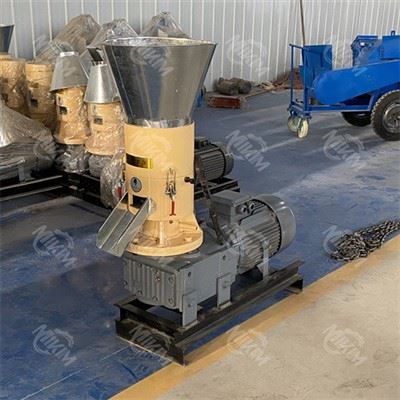
At a glance - Flat die machines are the "entry point" of pellet production: simple, affordable, and easy to maintain. They trade raw throughput for flexibility, which is exactly why they suit small-scale and mobile operations.
100–2,000 kg/h
Typical output range
2.2–110 kW
Motor power (electric or diesel)
2–12 mm
Pellet diameter
10–18%
Ideal raw moisture
500–1,200 h
Die service life
How a Flat die Biofuel Sawdust Pellet Machine Works
The process is straightforward and one of the reasons the machine is easy to operate and repair:
- Feed: Prepared biomass (ground, dried to 10–18% moisture, particle size < 6 mm) drops from a hopper onto the flat die.
- Compression: Rotating rollers press the material against the die surface. The friction and pressure (commonly 3–5 MPa) raise temperature, softening lignin so the fibres bond naturally - no chemical binder needed.
- Extrusion: Material is forced through the die holes and emerges as a continuous rod on the underside (or side) of the die.
- Cutting: A cutter at the outlet trims pellets to the required length (usually 20–50 mm).
- Discharge: Finished pellets fall into a collection bin, ready for cooling, screening, and bagging.
In most flat die designs either the die rotates and rollers are fixed, or the rollers rotate over a fixed die. Both achieve the same result; the former keeps material from piling at the centre and improves throughput.
MIKIM 100-250kg/h Flat Die biomass sawdust pellet machine | Factory Test Run
I am interested in this product
Flat Die vs Ring Die biomass granulator: Which Should You Choose?
The single biggest decision in biomass pelletizing is die type. The choice is not "which is better" but "which matches your scale." Here is the side-by-side:
| Parameter | Flat Die Machine | Ring Die Machine |
|---|---|---|
| Typical capacity | 100 kg/h – 1.6 t/h | 1 kg/h – 10+ t/h |
| Initial investment | Low (≈30–50% cheaper) | High |
| Compression pressure | ~3–5 MPa | ~8–15 MPa |
| Pellet density | 1.0–1.15 t/m³ | 1.1–1.3 t/m³ |
| Forming rate | 85–90% | 95%+ (PDI ≥ 97%) |
| Die life | 500–1,200 h | 1,200–2,000 h |
| Best for | Small farms, workshops, pilot plants, mobile use | Continuous industrial plants, export-grade fuel |
| Footprint | Compact, often wheel-mounted | Large, fixed installation |
Rule of thumb: If you need under ~2 t/h, work with softer materials (sawd *dust*, straw, husks), and value low cost and simple maintenance - choose flat die. If you need continuous, multi-shift production or export-grade density, choose ring die.
Technical Specifications (Reference Models)
The table below reflects typical flat die wood/sawdust pellet machine configurations from established manufacturers. Exact figures vary by model and material:
| Model | Capacity (kg/h) | Power (kW) | Weight (kg) | Dimensions (cm) |
|---|---|---|---|---|
| BH-125 | 80-100 | 3 | 95 | 110*35*70 |
| BH-150 | 90-150 | 4 | 100 | 115*35*80 |
| BH-210 | 200-300 | 7.5 | 100 | 115*45*95 |
| BH-230 | 250-350 | 11 | 250 | 138*46*100 |
| BH-260 | 400-500 | 15 | 320 | 130*53*105 |
| BH-300 | 600-800 | 22 | 415 | 145*62*120 |
| BH-360 | 900-1000 | 22 | 600 | 160*67*145 |
| BH-400 | 1200-1500 | 30 | 800 | 160*67*145 |
| BH-500 | 1500-1600 | 45 | 1000 | 196*88*150 |
Most machines run on three-phase 380V/50Hz power and can be supplied with an electric motor or a diesel engine for off-grid sites.
What Raw Materials Can It Process?
Flat die mills are remarkably versatile. Commonly used feedstocks include:
- Wood: sawdust, wood chips, shavings, branches, bamboo.
- Agricultural residue: wheat/rice/corn straw, rice husk, bagasse, peanut shell, sunflower stalk.
- Other biomass: leaves, shrubs, palm fibre (EFB), paper waste.
- Non-fuel uses: grain and meal for animal feed; manure/straw for organic fertilizer.

Tip: Keep moisture at 12–15% and particle size below 6 mm. Too wet → loose pellets and die clogging; too dry → low forming rate. A dryer or pre-mixer fixes most quality issues.
Where Flat Die Machines Are Used
- Household & farm heating - make your own wood pellets from on-site waste.
- Small pellet factories - supply local heating markets or small distributors.
- Livestock & poultry farms - produce fresh feed pellets on demand.
- Fertilizer production-turn manure and straw into organic granules.
- Pilot / R&D lines - test formulations before scaling to ring die.
Buying Guide: Is a Flat Die Machine Right for You?
Use this decision checklist before you buy:
- Output target: < 2 t/h → flat die is sufficient. ≥ 2 t/h continuous → ring die.
- Material type: Fine sawdust and straw favour flat die; hard, abrasive feedstock (oak bark, large chips) wears flat dies faster.
- Budget: Limited capital and lower per-machine cost matter more than lowest per-ton cost → flat die.
- Space & power: Small footprint and 10–40 HP (≈7.5–30 kW) suit workshops without heavy electrical infrastructure.
- Operation model: Intermittent, single-shift, or mobile → flat die. 20–24 h/day → ring die.
- Pellet quality: If you must meet strict export specs (density, low fines), ring die is safer.
Common mistakes to avoid
- Choosing the cheapest machine for industrial-scale demand.
- Ignoring raw-material moisture and particle size.
- Underestimating power supply requirements.
- Skipping after-sales support and spare-part availability.
Maintenance & Troubleshooting
Flat die machines are easy to service, but consistency matters:
- Rollers: Check clearance every shift; replace every ~1,000 hours.
- Die: Replace every 500–1,200 hours depending on abrasiveness; store with anti-rust oil.
- Lubrication: Grease bearings and gearbox per the manual; use the correct oil grade.
- Clogging: Usually from high moisture or oversized feed - stop, clear, and adjust.
- Low output: Worn die/rollers or wrong compression ratio are the usual causes.
FAQ
What is a flat-die biomass pellet machine?
A flat die biomass pellet machine is a compact pelletizer that presses loose biomass (sawdust, straw, wood chips) through a perforated flat steel disc using rotating rollers. It is designed for small to medium output (roughly 100 kg/h up to about 2 t/h) and is valued for low cost, simple operation, and easy maintenance.
What is the difference between a flat die and a ring die pellet machine?
A flat die machine uses a stationary or rotating flat perforated disc with rollers above it and is best for small-scale, flexible, low-budget production (typically under ~2 t/h). A ring die machine uses a rotating cylindrical die with rollers inside and is built for continuous industrial output (up to 20+ t/h) with higher pellet density and lower per-ton cost at scale.
What raw materials can a Flat die sawdust pellet mill process?
Flat die pellet mills handle a wide range of biomass: wood sawdust, wood chips, crop straw (wheat, corn, rice), rice husk, bagasse, peanut shell, bamboo, and other agricultural residues. The recommended raw-material moisture is 10–18%, ideally 12–15%, and particle size below 6 mm for best molding.
How much does a flat die biomass pellet machine cost?
Entry-level flat die machines typically range from about USD 1,000 for household units up to USD 8,000–15,000 for larger 1–2 t/h electric models. They are 30–50% cheaper than equivalent ring die machines, though per-ton maintenance is higher over time.
What pellet size and density can a flat die biomass pellet making machine produce?
Flat die machines commonly produce pellets of 2–12 mm diameter (6–10 mm is most common for wood fuel). Bulk density typically reaches 1.0–1.15 t/m³, with a pellet-forming rate of about 85–90%. For export-grade, ultra-dense pellets a ring die machine is usually preferred.
Why Trust This Guide
This article is produced by MIKIM Machinery, a manufacturer with over 10 years of experience in biomass and feed pellet equipment, exporting to Southeast Asia, the Middle East, Europe, and Africa. Our flat die and ring die machines are built with alloy-steel dies and gear-driven transmission, and our production is supported by CE certification and a complete after-sales system. Specifications cited here are drawn from standard industry configurations and verified product lines.
Need help choosing the right model?
Get a free, tailored recommendation from our engineering team - tell us your raw material, target output, and voltage, and we'll size the machine for you.
Hot Tags: Flat Die Biomass Pellet Machine, China Flat Die Biomass Pellet Machine manufacturers, suppliers, factory, wood pellet conveying machine, wood pelletizer, wood pellet packing machine, diesel pellet mill, wood pellet density machine, heating pellet machine
You Might Also Like


Send Inquiry
