


What Are the Core Components of biomass Sawdust Pellet Making Machine and How Do They Work Together?
content
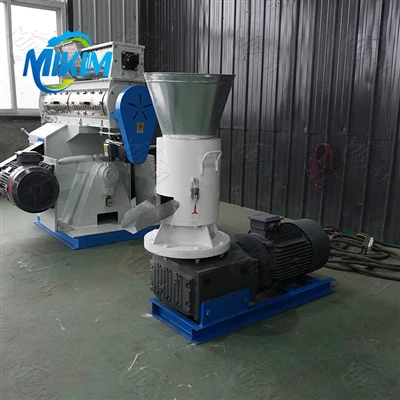
First, there's the feeding system, the "source of support" for the small biomass pellet maker machine. Its core components include the feed hopper, screw feeder, and feed plate (or conditioner). Its function is to stably and evenly deliver the pre-treated wood chips to the pressing system. The feed hopper stores the raw material, avoiding frequent feeding. The screw feeder, driven by a motor, pushes the material at a uniform speed; its rotation speed can be adjusted via a frequency converter to precisely match the pressing system's processing capacity, preventing material accumulation that could overload the equipment, or insufficient material that could cause the pressure rollers to idle and wear. For ring die machines, the feeding system also includes a conditioner, which uses steam or water to regulate the moisture and temperature of the raw material, increasing its viscosity. Flat die machines are equipped with a feed plate to evenly distribute the material on the flat die surface, ensuring uniform pressing.
Second, there's the pressing system, the "core working area" of the second-hand biomass pellet machine. Its core components include the pressure rollers, the die (flat or ring die), and the cutter. Its function is to shape the raw material through extrusion. The pressure roller is a key component for transmitting pressure. Its surface has anti-slip textures to increase friction with the raw material and prevent slippage. The die is crucial for forming the pellets; the die hole specifications determine the pellet diameter. In a flat die machine, the die remains stationary while the pressure roller rotates to compress the raw material. In a ring die machine, the die rotates, and the pressure roller rotates passively; the two work together to generate high pressure. The cutter is used to cut the formed cylindrical pellets and control their length. In a flat die machine, the cutter is installed on the outside of the die hole; in a ring die machine, the cutter is installed on the outside of the ring die as needed, and its speed is adjustable. The performance of the pressing system directly determines the pellet density, hardness, and forming rate, making it the most crucial part of the equipment.
Then comes the transmission system, the "power transmission hub" of the domestic wood pellet machine. Its core components include the motor, gearbox, and coupling, and its function is to precisely transmit the motor's power to the pressing and feeding systems. The motor is the power source, with different power ratings selected based on equipment capacity (15-22kW for small machines, 110-250kW for large machines). The gearbox reduces motor speed and increases torque, ensuring sufficient extrusion pressure in the pressing system. Flat die machines often use belt drives with gearboxes, while ring die machines typically use hardened gearboxes for higher transmission efficiency and stability. Couplings connect the motor to the gearbox and the gearbox to the working parts, acting as buffers and protectors to prevent impact damage during power transmission. The stability of the transmission system directly affects the smooth operation and lifespan of the equipment.
Finally, the making machine's discharge system, with core components including the discharge port, cooling device, and screening device, smoothly discharges the formed granules for subsequent processing. The discharge port guides the granules downwards, preventing accumulation in the pressing chamber; the cooling device (commonly air-cooled) lowers the temperature of the high-temperature granules, preventing moisture absorption and deterioration, and improving storage stability; the screening device removes defective granules (loose, cracked, powdery), ensuring finished product quality. The logic of the coordinated operation of the various systems is as follows: the feeding system accurately delivers the raw materials to the pressing system, the transmission system provides stable power to both systems, the pressing system extrudes the raw materials into shape, and the discharge system completes the finished product processing. The entire process is continuous and smooth, ensuring stable and efficient operation of the equipment.
Related equipment


about us
Customer visit

Certificate of Honor

FAQ
1.What is the price of equipment for the bagasse pellet machine?
It costs approximately US$1,500.00 - 25,000.00
2. If equipments have some quality problem, how would you deal with?
We will responsible for all the quality problems. Change all the parts for free.


