


How to Use a Biomass Charcoal Briquette Making Machine: Step-by-Step Operating Guide
Need technical support for your briquetting line? Contact our engineering team →
A biomass briquetting machine turns loose agricultural and forestry residue - sawdust, rice husk, groundnut shell, bagasse - into dense, burnable logs without any chemical binder. Getting it right takes about an hour of setup and a disciplined daily routine. This guide walks through every step, from positioning the machine on your shop floor to shutting it down at the end of a shift, with notes on the common mistakes that damage dies and waste material.
Key Takeaways
- Feedstock moisture is the #1 quality variable: aim for 8–15% (wet basis). Too wet = weak briquettes and die blockages. Too dry = the lignin doesn't plasticise and briquettes crumble.
- Never cold-feed production material: always run 10–15 minutes of warm-up with low-value scrap material to bring the die to operating temperature (typically 150–280 °C, depending on machine type).
- Current draw tells you everything: a sudden spike means a blockage or oversized particle; a drop means bridging in the hopper. Watch the ammeter, not just the output chute.
- Shutdown is as important as startup: never cut power with material still in the compression chamber. Cool down with dry scrap, then clean the die face before the residue hardens.
1. What a Biomass Charcoal Briquette Making Machine Does
Briquetting is a densification process: loose biomass with a bulk density of 80–150 kg/m³ gets compressed into logs or blocks with a density of 800–1,200 kg/m³. The machine does this through one of three mechanisms - mechanical stamping (piston press), screw extrusion, or hydraulic compression - all relying on heat, pressure and the natural lignin in the feedstock to bind the material without additives.
Briquettes replace coal, fuel oil (FO), light diesel oil (LDO) and firewood in three main applications:
- Industrial steam boilers - textile mills, food processing plants, chemical factories converting from coal to biomass under emissions regulations.
- Drying kilns - tea processing, tobacco curing, timber drying, where clean, steady heat matters.
- Gasification plants - briquettes serve as feedstock for biomass gasifiers producing syngas for power generation or process heat.
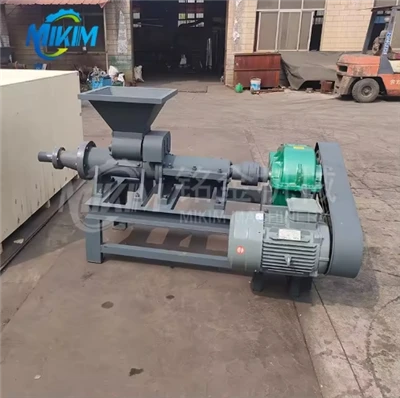
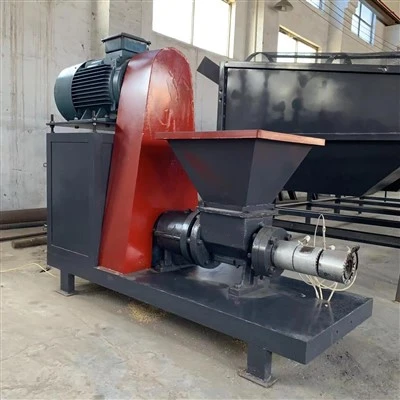
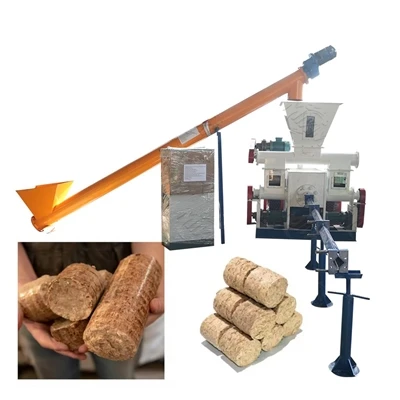
2. MIKIM Series biomass charcoal making machine Specifications
The MIKIM range covers small workshops to mid-size industrial plants. Capacity figures below are for mixed hardwood sawdust at 10–12% moisture; actual output varies with feedstock type, particle size and moisture.
| Model | Motor Power (kW) | Die Holes | Capacity (t/h)* |
|---|---|---|---|
| MIKIM-36 | 45 | 36 | 0.5–1.0 |
| MIKIM-48 | 75 | 48 | 1.0–1.5 |
| MIKIM-72 | 110 | 72 | 2.0–2.5 |
| MIKIM-90 | 132 | 90 | 2.0–2.5 |
| MIKIM-120 | 200 | 120 | 3.0–4.0 |
| MIKIM-150 | 250 | 150 | 4.0–6.0 |
*Capacity in tonnes per hour for industrial-grade solid briquettes. Output depends on feedstock type, particle size and moisture content. Figures above are nominal; confirm with a trial run on your specific material.
3. Pre-Start Checks: Machine Positioning and Foundation
Floor and anchoring
Place the biomass briquettes manufacturing machine on a level concrete floor rated for the dynamic load. Bolt it down through the base frame - vibration is the enemy of consistent briquette density and will loosen anchor bolts within days if the foundation flexes. For the MKYK-120 and larger, cast a dedicated plinth with M20 anchor bolts on the machine's bolt pattern.
Power connection
All MKYK models run on 380 V three-phase. Check phase sequence before first start: a reversed phase will spin the main shaft backwards, which destroys the die within seconds. Use a phase rotation meter or have an electrician confirm. Install an overload relay set to the motor's full-load current plus 5–10% headroom.
Lubrication and clearance
- Check gearbox oil level through the sight glass. Use ISO VG 220 or equivalent industrial gear oil for ambient temperatures above 15 °C.
- Grease all bearing nipples - main shaft bearings, roller eccentric shaft bearings - with lithium-based EP2 grease. Do this daily.
- Visually inspect the roller-to-die gap. On a mechanical stamping press, the ram should travel freely without scoring the guide bushing. Remove any hardened residue from the previous shift.
4. First Startup: Warm-Up Procedure
Starting cold is the fastest way to damage a briquetting die. The compression zone needs to reach operating temperature before production feedstock enters.
- Start the main motor with the hopper gate closed. Let the machine run under no load for 2–3 minutes. Listen for unusual noise-knocking, grinding, or a rhythmic thump that suggests an unbalanced roller or loose die clamp.
- Feed warm-up material. Open the hopper gate partially and feed dry, low-value material-coarse sawdust, ground rice husk, or production rejects crushed back to particles. Run 10–15 minutes at 50–70% feed rate.
- Check temperature. The die surface should reach roughly 150–180 °C on a Stamping Biomass Briquette Press machine and 220–280 °C on a screw-type biomass brick press machine. If you don't have an infrared thermometer, watch the briquette surface: it should emerge with a slight sheen (lignin plasticization) and a consistent dark-brown color, not charred black.
- Transition to production feedstock. Once the die is hot and the warm-up briquettes are forming cleanly, switch to your production material at the target feed rate. Make the switch gradually over 2–3 minutes.
bio-briquette manufacturing machine test
I am interested in this product
Safety note: The die face, compression zone and freshly ejected briquettes are hot enough to cause serious burns. Keep hands and loose clothing clear. Operators must wear heat-resistant gloves, safety glasses and steel-toe boots. Do not use water to cool the die while the machine is running - thermal shock cracks carbide dies.
5. Raw Material Preparation: What Goes In Determines What Comes Out
Particle size
Feedstock should be screened to a maximum particle size of 5–6 mm for piston stamping wood briquette press machines and below 3–4 mm for screw-type biomass briquette making machines. Oversize particles create voids inside the briquette that cause fracture planes. A hammer mill or knife chipper upstream handles this; set the screen size conservatively.
Moisture content
The target window for most briquetting technologies is 8–15% moisture (wet basis). A fast field test: squeeze a handful of feedstock tightly. If it clumps and then crumbles when you let go, moisture is about right. If water drips out, it's too wet. If it doesn't clump at all, it's too dry. For production, use a moisture meter - they cost less than a replacement die.
Feedstock that arrives at 25–40% moisture (fresh sawmill residue, wet agricultural waste) must be dried before briquetting. A rotary drum dryer or flash dryer upstream is standard equipment for any line above 1 t/h.
Feedstock types and their briquetting behaviour
| Feedstock | Briquette Quality | Notes |
|---|---|---|
| Hardwood sawdust (oak, beech, acacia) | Excellent | High lignin content binds well; produces dense, high-calorific-value briquettes. |
| Softwood sawdust (pine, spruce) | Good | Resin aids binding but causes die build-up over time; clean die face more often. |
| Rice husk | Moderate | High silica content increases die wear. Mix 30–50% with sawdust for better results. Ash content ~20%, which limits boiler applications. |
| Groundnut shell | Good | Briquettes burn well but have lower mechanical durability; may need a higher compression ratio. |
| Bagasse (sugar cane residue) | Moderate | High moisture when fresh; must be dried thoroughly. Fibrous structure helps binding. |
| Straw (wheat, rice, corn) | Moderate | Low lignin; high ash (5–10%). Best blended with woody biomass at 30–50%. |
Briquetting behaviour is indicative. Always test your specific feedstock batch. Ash content and calorific value data are typical ranges from published biomass databases; confirm with lab analysis for contractual quality specifications.
6. Production Operation: Feeding and Current Control
Once the machine is at temperature and the feedstock is correctly prepared, production operation has three main control points:
Feed rate control
Set the feed rate so the main motor draws 80–90% of its rated full-load current. Running below 70% wastes capacity; running above 95% risks over-current trips every time feedstock density varies. On the MKYK-72 (110 kW motor), for example, target 160–180 A per phase at 380 V.
Reading the ammeter
- Steady current at 80–90% FLC: normal, optimal production.
- Sudden spike (above 100% FLC): a large particle, foreign object or compacted material has hit the compression zone. Reduce feed immediately. If the spike doesn't clear, stop and inspect.
- Gradual current drop: the hopper is bridging - material is arching above the feed throat and not reaching the screw or ram. Tap the hopper wall (never reach in) or use a mechanical vibrator.
- Cyclic fluctuation (5–10% swing every few seconds): normal on a mechanical stamping press as the ram cycles. The swing should be regular. An irregular pattern means inconsistent feed.
Roller-to-die gap adjustment
On ring-die and flat-die briquetting presses, the gap between the roller and the die face determines compaction pressure. Too wide (>1.5–2 mm) and briquettes are soft; too tight and the roller scuffs the die. Adjust to 0.5–1.0 mm using a feeler gauge, measured cold. Check every 50–80 operating hours as the roller surface wears.
7. Quality Checks During Production
Pull a sample briquette every 30 minutes and check three things:
- Surface finish: smooth, with a visible sheen from plasticised lignin. Dull, rough briquettes mean the die is too cold or moisture is too low. Charred or smoking briquettes mean the die is too hot - reduce feed rate or check for die friction.
- Drop test: drop a briquette from 1 metre onto concrete. It should survive intact with minor edge spalling. If it shatters, increase compaction pressure (reduce roller gap) or raise feedstock moisture by 1–2%.
- Length consistency: briquette length should not vary by more than ±10%. Inconsistent length usually traces back to uneven feed from the hopper or a worn screw/conveyor.
8. Shutdown Procedure
Shutdown done wrong leaves hardened material in the die that must be chiselled out the next morning. Do it right:
- Stop feedstock flow first. Close the hopper gate but keep the machine running.
- Purge with dry scrap. Feed a small amount (2–3 kg) of dry, coarse sawdust or rice husk. This absorbs residual moisture and pushes the last production material through the die. Run until the current drops and the briquettes emerging are from the purge material, not production feedstock.
- Stop the main motor.
- Clean the die face immediately while it is still warm. Use a brass scraper or soft wire brush - never a steel chisel or hammer on a carbide or hardened-steel die. Remove all compacted residue from the die holes and roller surface.
- Apply a light oil coat (SAE 30 or similar) to the die face and rollers if the machine will sit idle for more than 24 hours. This prevents rust on uncoated steel surfaces.


9. Common Problems and Quick Fixes
| Symptom | Likely Cause | Fix |
|---|---|---|
| Briquettes crumble or are soft | Moisture too low (<6%); die too cold; roller gap too wide | Add 1–2% moisture; extend warm-up; close roller gap to 0.5–1.0 mm |
| Briquettes have surface cracks | Moisture too low; particle size too coarse; cold die | Check moisture; screen to <5 mm; increase warm-up time |
| Machine jams / current spike | Oversize particle; foreign object; wet material slug | Stop immediately; clear compression chamber; screen feedstock |
| Low output rate | Worn die or roller; incorrect feed rate; bridging in hopper | Inspect die/roller wear; adjust feed; install hopper vibrator |
| Smoke from die area | Feedstock too dry; excessive die friction; inadequate cooling | Check moisture; reduce feed rate temporarily; verify die lubrication |
| Uneven briquette length | Inconsistent feed; worn screw conveyor; partial die blockage | Check feeder; inspect screw flights; clear blocked die holes |
10. Briquette Quality Standards and Fuel Properties
If your customer specifies briquette quality against a formal standard, the international reference is ISO 17225-3:2021 (Graded wood briquettes). This standard defines quality classes A1, A2 and B based on parameters including:
- Ash content: A1 ≤ 0.7%, A2 ≤ 1.2%, B ≤ 2.0% (dry basis)
- Mechanical durability: ≥ 97.5% for A1 and A2 (tested per ISO 17831-1)
- Moisture: typically ≤ 10% for all classes
- Net calorific value: ≥ 16.5 MJ/kg for A1 and A2 (dry basis)
For end-use combustion equipment, EN 15270:2007 covers pellet burners for small heating boilers up to 70 kW, while larger industrial biomass boilers follow EN 303-5 or national equivalents. These are equipment standards, not fuel standards, but your customer's boiler specification will often cross-reference them.
Briquette quality specifications should be agreed contractually between supplier and buyer before production starts. The ISO class alone does not guarantee suitability for a specific boiler - ash chemistry (slagging, fouling, corrosion), not just ash percentage, matters for industrial combustion equipment.
FAQ
Q1. What moisture content should the raw material have for briquetting?
Most Piston Stamping Biochar Briquettes Making Press Machine and Screw Type wood chip briquette maker machines work best with feedstock at 8–15% moisture content (wet basis). Material that is too wet produces weak, crumbly briquettes and can cause steam explosions at the die. Material that is too dry lacks the natural lignin binding needed for density and may require higher compression force. Always test a small batch before full production - your specific feedstock and machine combination may have a narrower optimal window.
Q2. What is the difference between a Wood Waste Charcoal Briquette Making Machine and a Wood Chip Pellet Making Machine?
Wood Waste Charcoal Briquette Making Machines produce larger-diameter solid fuel logs or blocks (typically 50–90 mm diameter), while Wood Chip Pellet Making Machines produce smaller cylindrical pellets (6–12 mm). Briquettes are often used in industrial boilers, gasifiers and open fires; pellets are preferred for automated feeding systems in residential and small commercial stoves and boilers. Briquetting generally tolerates larger particle size and slightly higher moisture than pelleting. The two processes share the same principle - compressing biomass to increase density - but differ in die geometry, pressure and end-use.
Q3. How do I stop briquettes from cracking after they come out of the machine?
Surface cracking usually has three possible causes: (1) feedstock moisture is too low (below 6–8%), so lignin does not plasticise properly during compression; (2) die temperature is too low during startup - run a few minutes of warm-up material before feeding production feedstock; (3) particle size is too coarse or inconsistent - material should be screened to below 5–6 mm. Adjust moisture first, then check temperature, then check particle size. In most cases the moisture is the culprit.
References
- ISO 17225-3:2021 - Solid biofuels - Fuel specifications and classes - Part 3: Graded wood briquettes. https://www.iso.org/standard/76089.html (published 2021)
- EN 15270:2007 - Pellet burners for small heating boilers - Definitions, requirements, testing, marking. https://standards.iteh.ai/catalog/standards/cen/2dbe8845-9f0d-4b9f-a744-9ed1e3a7fbe4/en-15270-2007 (published 2007)
- ISO 17831-1:2015 - Solid biofuels - Determination of mechanical durability of pellets and briquettes - Part 1: Pellets. https://www.iso.org/standard/60648.html (published 2015)
- ENplus® Wood Pellet Certification Scheme. European Pellet Council. https://enplus-pellets.eu/ (accessed 2026-08-06) - relevant for pellet quality context; briquette certification schemes differ.
All standards and references above were verified against official sources as of the publication date. Operating parameters are based on manufacturer guidance and field experience with the MKYK series. Always follow the specific instruction manual for your machine model.
Need a Briquetting Machine or Spare Parts?
Tell us your feedstock type, target output (tonnes per hour) and available power supply. We'll recommend the right MIKIM model and prepare a quotation.
Or email wood@mikimz.com · WhatsApp +86 199 1372 6062
Our Factory
Packaging & Shipping

Quality Certifications


