


How does a wood briquette press machine work
content
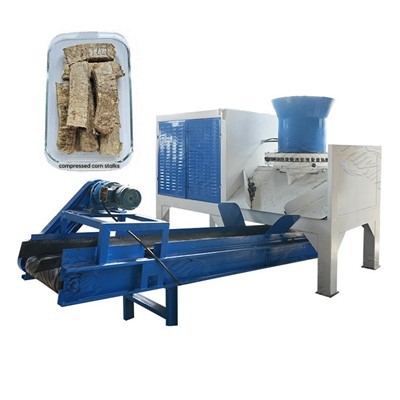
The core working principle of a wood chip briquette press is "mechanical pressure + lignin self-bonding." It uses high-pressure extrusion to densely shape wood chips without the need for additional binders, similar to the forming principle of a wood pellet mill. However, the pressure transmission method and forming structure are fundamentally different. Its complete workflow can be divided into four main steps: raw material pretreatment, feeding and conveying, high-pressure forming, and finished product cutting and cooling. Each step is interconnected and directly affects the density and forming effect of the block fuel.
The first step, raw material pretreatment, is fundamental to the normal operation of a wood shavings briquette maker. Its requirements are similar to, but slightly different from, those of a wood pellet mill. The wood chips must first be crushed, with the particle size controlled between 2-8mm. Too large a particle size can cause jamming and uneven forming, while too small a particle size will increase equipment wear. The moisture content must be strictly controlled between 8%-12%. Higher moisture content will cause the finished product to crack and become loose, while lower moisture content will make forming difficult due to the difficulty in softening the lignin. The optimal moisture content for a wood pellet mill is 12%-15%, offering a higher tolerance for error. Pre-treated wood chips must be screened to remove impurities such as stones and metal to prevent damage to the core components of the equipment.
The second step, feeding and high-pressure molding, is the core of the biomass briquette press operation. Pre-treated wood chips are fed uniformly into the molding cavity via a screw feeder to prevent uneven stress caused by material accumulation. The molding cavity is equipped with pressure rollers and molds (flat or ring mold structures, similar to wood pellet mills, but with larger mold orifices, typically 20-50mm). A motor drives the pressure rollers to rotate via a transmission system, applying a high pressure of 10-30MPa to the wood chips. Simultaneously, an external heating device maintains the temperature at 160-200℃, softening and melting the lignin in the wood chips to form a natural binder. Under the combined action of high pressure and high temperature, the wood chips are squeezed into the mold orifice, forming a dense columnar body.
The third step is finished product cutting and cooling, completing the final molding process. After being extruded from a hydraulic sawdust briquette press mold, the cylindrical material is cut into uniformly sized fuel blocks (length adjustable from 5-20cm) by a pre-set cutter. The freshly formed product is at a high temperature and needs to be cooled naturally or with a cooling device to room temperature to prevent moisture absorption and deterioration. The cooled fuel blocks have a density of 1.1-1.3 g/cm³ and a calorific value of approximately 4500-5000 kcal/kg. Their combustion efficiency is far higher than that of loose sawdust, making them suitable for direct use in heating, industrial heating, and other applications.
Related equipment

about us
Customer visit

Certificate of Honor

FAQ
1.What is the price of equipment for the charcoal briquette press?
It costs approximately US$1,500.00 - 25,000.00
2. If equipments have some quality problem, how would you deal with?
We will responsible for all the quality problems. Change all the parts for free.


