

Products


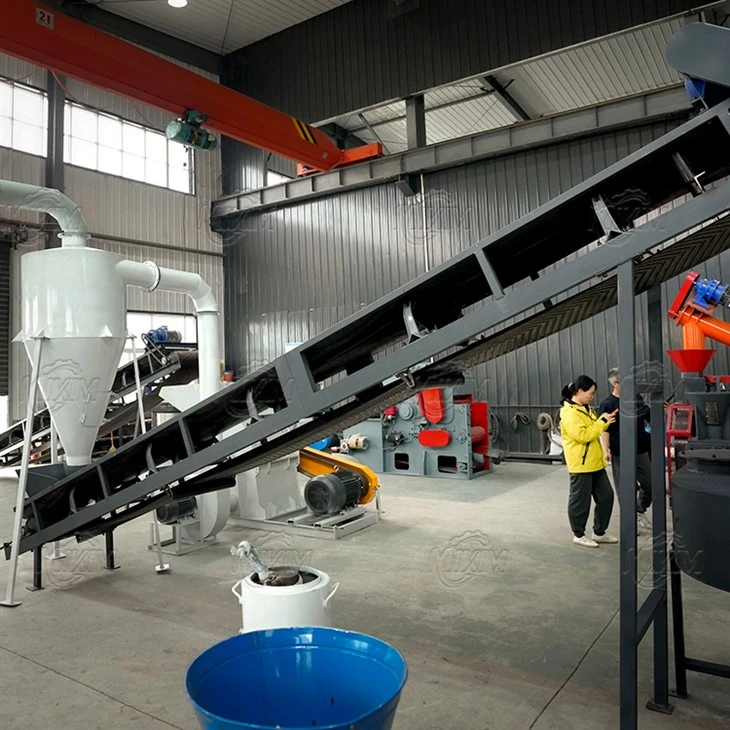
200-300 kg/h Micro Sawdust Briquette Line with Carbonization
This 200–300 kg/h Micro Sawdust Briquette Line makes 50 mm hollow hexagonal or square briquettes, formed when natural lignin binds the material under heat and pressure.
Features
Quick answer
A 200-300 kg/h micro sawdust briquette line pairs a screw press that extrudes 50 mm hexagonal rods with a batch retort that carbonizes 2.5-3 t per day. One eight hour pressing shift makes 1.6-2.0 t, which one retort charge takes in full. Connected load is 18.72 kW, and carbonizing itself draws no power.
1T-3T/H Rice Husk Carbonization Production Line Factory Tour | Actual Footage
1-1.5 t/h Combustible Charcoal Briquette Production Line test in our factory
01
Sawdust moisture between 5 and 12 percent
The window is fixed by the press, and it is narrow. Sawdust wetter than the window makes a rod with a soft skin that slumps in the stack. Sawdust drier than it does not bond at all, and the rod crumbles at the die.
So the dryer sits upstream of the press. An air duct dryer brings sawdust into the window before it reaches the hopper.
Dryer ahead of the screw press
A duct dryer suits this scale because the tonnage is small and the run is short. Sawdust enters the hot air at the inlet and leaves the cyclone ready for the hopper. The dryer does not need to be large, it needs to be steady, because the press cannot compensate for a load that arrives wet.
Digital moisture meter at the press inlet
A meter at the inlet is the only instrument that tells the operator whether the next hour makes saleable rods or scrap. Read it before the shift and after every feedstock delivery.
The equipment upstream of the press is set out under biomass briquette production equipment.

02
A screw type press briquetting machine forming 50 mm rods
A screw turns inside a heated barrel and pushes sawdust against a die. The die sets the section, the heating rings set the temperature, the screw sets the pressure, and rod leaves the die in a 50 mm hexagonal section.
Stage
Model
Power
Rod pressing
BJ-50, 200-250 kg/h, 50 mm, 5-12 percent moisture
18.5 kW
Carbonizing
QHL-1, 2.5-3 t/24h, one outer furnace, three baskets, 3 t hoist, one purification tank
0.22 kW
Total
18.72 kW
Table 1: Equipment and connected load of the 200-300 kg/h sawdust briquette line.
The 0.22 kW against carbonizing is the hoist, not the furnace.


Hexagonal rod with a centre hole
The hexagon is a handling shape. Flat faces stack in the basket and in the sack, so rods do not roll and the load sits square in the furnace.
The centre hole is a combustion feature. Air passes through the bore while the rod burns, so the inside releases its heat with the outside instead of charring on the surface.
18.5 kW motor on 380 V three-phase
The main motor is 18.5 kW on 380 V three-phase, a supply most workshops already have. It drives the screw against the die and is the only heavy load on the line. Starting current is the one thing to raise with an electrician, because the motor starts under load every time the barrel fills.
The press itself is described under biomass rod press for hexagonal briquettes.
03
Do Sawdust Briquettes from screw-type wood briquette press machines Require Additives?
No binder
No binder added to the sawdust briquette. Heat from the barrel and pressure from the screw soften the lignin in the wood, and the lignin does the bonding as the material passes the die.
That is why the moisture window matters. Water is the only thing in the barrel that can be adjusted, and it decides whether the lignin softens at the temperature the rings hold.
A line that needs no binder also needs no mixing stage, no binder store and no dosing equipment. The yard holds one material and the machine takes it straight from the pile.
The press takes bamboo powder, sawdust, wood shavings and rice husk. Each behaves a little differently at the die, so a feedstock change is worth a check on the meter rather than an assumption.
04
Which die shape suits a 50 mm rod?
Two die shapes ship with the press, and the choice is about handling rather than quality. Both form a 50 mm rod with a bore through the centre, and both sets cover 50-80 mm, so a line can change section without changing machine.
Hexagonal die with the centre hole
Hexagonal rods stack without rolling and leave gaps in the basket, which lets heat move through the charge. That is the shape most charcoal lines run.
Square die as the second shape
Square rods pack tighter, so a basket holds more of them and a furnace charge carries more weight. The trade is in airflow through the stack, which is why the square die is a second shape rather than the default.


05
One shift of pressing at 200 kg/h
The press runs at 200-250 kg/h, so an eight hour shift produces 1.6-2.0 t of rods. That is the number the whole line is planned around, and it is the number to quote when a buyer asks what a day looks like.
A yard that ordered the press first and the retort later learned where the losses sit. Rods stacked wet went soft at the edges within a day, and the stack had to be broken up and fed back through the dryer. The press was running at rate the whole time; the material going into it was not.
Output falls below the rating for three reasons: a worn die, a feedstock outside the window, and a screw shaft that no longer fills the barrel.
06
How many hours of pressing fill one retort?
Two rhythms
Pressing is measured in hours and carbonizing in charges. One shift of pressing makes 1.6-2.0 t, and one retort takes 2.5-3 t per day, so a single shift fills a single furnace with room to spare.
That is the pairing this line is built on. The press does not have to run all day for the retort to work, and the retort does not have to be fed while it burns.
Pressing pattern
Rod output
Retort fit
One 8 hour shift
1.6-2.0 t
QHL-1, 2.5-3 t/24h, one outer furnace
Pressing round the clock
4.8-6.0 t
QHL-2, 5-6 t/24h, two outer furnaces
Table 2: Pressing and retort rhythm on the 200-300 kg/h briquette line.
2.5 to 3 t per day through one retort
One retort takes 2.5-3 t per day, which covers a shift of pressing and leaves capacity in the furnace. That surplus is what allows a second shift on a good week without buying anything.
Three baskets stacked in the furnace
The charge is three baskets, and three baskets stack inside one outer furnace. Stacking is what makes the daily tonnage possible from a furnace with a small footprint.
07
A retort with three inner baskets
The retort set is three parts. Baskets hold the rods, the hoist lifts them, and the purification tank handles the gas.
Baskets and sealing lids are heat resistant steel, because they sit in the fire and come out hot. Three baskets stack inside one outer furnace, and the whole set weighs 3.3 t.
The hoist is a steel frame with an electric hoist rated at 3 t, drawing 0.22 kW. Carbonizing draws no power at all: once the baskets are in and the lid is on, the furnace burns on its own.


08
Loading, firing and unloading a briquette batch
The cycle has four steps and they run in the same order. Fill the baskets, set the lids, lift them into the furnace, fire. When the burn is done, the charge cools before the hoist takes the baskets out.
Cooling is the step that gets skipped under time pressure, and skipping it costs the batch. Char that comes out hot meets air and cracks, and a basket of cracked briquettes sells as fines.
A crew that ran three batches a week on a tight schedule tried unloading straight from the furnace to save an evening. The briquettes came out whole and broke in the sack two days later, and the sack was what the trade saw.
09
Flue gas through the purification tank
Smoke from the retort is not released as smoke. The gas leaves the furnace, passes the purification tank, and leaves the stack as water vapour.
That is what makes the process usable in a yard with neighbours. The visible plume disappears and the tar stays in the tank.
Tar filtered out of the smoke
The purification tank and the waste heat circulation duct work as one system. Non-combustible gas passes through, wood tar is filtered out and collected, and the gas that remains is clean enough to release.
Steam out of the stack after cleaning
After cleaning, the flue gas leaves the stack as steam. Nothing visible, nothing tarry on the roof, and no smoke complaint to answer at the yard gate.
10
When 24 hour pressing needs a second retort
Retort ceiling
Pressing round the clock makes 4.8-6.0 t per day. One retort takes 2.5-3 t per day, so it cannot take that output. The two furnace set, rated 5-6 t per day, is the answer.
Running the press on three shifts is a decision about the retort, not the press. The press will run all night and build a pile the furnace cannot swallow.
The two furnace set carries two outer furnaces, six baskets, a 5 t hoist and two purification tanks on 1.5 kW. At 6.8 t against 3.3 t, it changes what the floor has to carry.
The full charcoal sets are compared under complete charcoal carbonization set with a retort.
4.8 to 6.0 t per day from continuous pressing
Continuous pressing is how a yard moves from one furnace to two. The number to plan against is 4.8-6.0 t per day, not the shift figure.
Two furnaces and six baskets in the larger set
Two furnaces and six baskets double the daily intake and let one burn while the other loads. That gap between charges is what keeps a continuous press fed.
11
Bagging char briquettes with a heat sealer
Char briquettes go into sacks closed with a manual heat sealer, a heavy pattern unit worked by hand that suits this output better than an automatic closer.
Sealing comes last, after the moisture reading. A sack sealed over damp char traps the moisture inside and the briquettes soften in storage.
The sealer closes the sack along a welded seam, which keeps air out and the fine charcoal dust in. Bag film and a spare heating element are the consumables to keep on the shelf, and the meter from the press inlet goes to the bagger for the last check on a batch.
12
Spare dies, screw shafts and heating rings
The wear parts are listed line by line on the order rather than bundled into the machine price.
Item
Specification
Quantity
Hexagonal perforated die
50-80 mm
1 set
Square perforated die
50-80 mm
1 set
Screw shaft
as fitted to the press
4
Heating ring
350 deg C
3 sets
Hard facing electrode
30 kg
1 lot
Manual heat sealer
heavy pattern
1
Digital moisture meter
hand held
1
Table 3: Spare parts and tooling listed line by line on the order.
Each is opened as a separate line on the order list, with its own specification and quantity. None carries a model number or a power rating.
Four screw shafts in the spare list
The screw shaft is the part that wears fastest, because it works against the die under load. Four shafts on the shelf means a worn screw is a changeover, not a shutdown.
Three heating rings at 350 deg C
Three heating rings rated at 350 deg C keep the barrel at temperature, and three sets cover the positions on the barrel. A failed ring shows up as a rod with a dull surface before it shows up as a stoppage.
30 kg of hard facing electrodes
Hard facing keeps the screw flights and the die face in shape between replacements. Thirty kilos covers a season of rebuilding at this output.
13
FOB Qingdao and CIF Maputo terms
The commercial side is quoted two ways. FOB Qingdao or Ningbo prices each item at the port of loading, and CIF Maputo adds freight and insurance through to the port in Mozambique, where the inland leg to the works begins.
Pricing is item by item, not one figure for the set. Press, retort, hoist, purification tank, sealer, meter and every spare line carry their own value, so a line can be added or dropped without renegotiating the order.
Gross weight and packed volume are given package by package on the packing list. The two main items are heavy and the spares are light, so the total is summed from the list.
Delivery is quoted in weeks from order confirmation, with the packing list issued before shipment so the container plan can be checked.
Send sawdust source and daily output and the quotation comes back with the press and retort priced as separate lines.
The line works when the two clocks are read together. A shift of pressing makes 1.6-2.0 t, one retort takes 2.5-3 t per day, and the yard needs no more than that. Add a second shift and the question becomes a second furnace, not a bigger press.
Three numbers carry the decision. Moisture sits between 5 and 12 percent at the press inlet, the rod leaves the die at 50 mm with a bore through it, and the retort takes its charge in baskets rather than in a stream. A 200-300 kg/h micro sawdust briquette line is not a small version of a continuous plant. It is a press and a furnace on two different clocks.
1
What moisture should sawdust have before the screw-type wood dust charcoal briquetting machine?
Between 5 and 12 percent. A duct dryer upstream brings the sawdust into that window, and a digital meter at the inlet checks every delivery.
2
Do sawdust briquettes need a binder to keep their shape?
No. Heat from the barrel and pressure from the screw soften the lignin in the wood, and the lignin bonds the particles as they pass the die.
3
Why are the rods hexagonal with a hole in the middle?
The flat faces stack without rolling in the basket and in the sack. The bore lets air through the briquette while it burns, so the inside releases heat with the outside.
4
How does 200 kg/h of pressing compare with one retort?
A 200-300 kg/h micro sawdust briquette line presses 1.6-2.0 t in an eight hour shift, and one retort takes 2.5-3 t per day, so a shift fills a furnace with capacity left.
5
What happens to the flue gas during carbonization?
The gas passes the purification tank, wood tar is filtered out, and what leaves the stack is water vapour. Carbonizing itself draws no power.
6
Which spare parts should I keep on hand?
A 50-80 mm hexagonal die set and a square set, four screw shafts, three heating rings at 350 deg C and 30 kg of hard facing electrodes.
7
What is the difference between FOB Qingdao and CIF Maputo?
FOB prices each item at Qingdao or Ningbo. CIF Maputo adds ocean freight and insurance to the destination port. Both are quoted item by item.
Hot Tags: 200-300 kg/h Micro Sawdust Briquette Line with Carbonization, China 200-300 kg/h Micro Sawdust Briquette Line with Carbonization manufacturers, suppliers, factory, biomass briquettes machine with cutter, stamping sawdust Briquette Machine, round briquettes, biomass briquetting machine, biomass briquettes machine with dryer, biomass briquettes machine for waste heaters
Previous:
You Might Also Like


Send Inquiry
