

Products


500 kg/h Ring Die Biomass Pellet Line
This page answers the brief for a 500kg/h ring die biomass pellet line in the order the decision is made: what stays, where capacity is measured, which frame carries it, what the die and lubrication answers are, how a 15 kg bag is closed, what the interface checklist holds, which spares come first, what connected power the machines add, and how a retrofit is quoted.
Features
Quick answer
A 500kg/h ring die biomass pellet line built onto an existing 100-200 kg/h sawdust line replaces four items and keeps the rest: a ring die press on a 1-1.5 t/h frame run at part load, a chip pulveriser, a 15 kg bagging scale with a separately quoted heat-sealing station, and a first spare set. The frame, the two die diameters, the interface points and the power total are fixed on one confirmation sheet before any quotation is issued.
▪
Four items are replaced; the existing crusher, silo and part of the conveying stay in service.
▪
The press is a 90 kW frame rated 1-1.5 t/h, so 500 kg/h sits at 33-50% of its rated band.
▪
The 4-12 mm die range covers both the 6 mm and the 8 mm die requested, one set of each.
▪
Automatic central lubrication is not stated for the wood range: to be confirmed against the factory technical confirmation sheet.
▪
Heat sealing is not part of the standard bagging unit: a horizontal heat-sealing station is quoted separately and confirmed per project.
A sawdust line running at 100-200 kg/h does not have to be scrapped to reach 500 kg/h. The crusher, hopper, dust ducting, floor and power connection all keep working; what fails is the press, and the parts bought to match it.

01
Which Stations of a 100-200 kg/h Line Stay at 500 kg/h?
How to sort retained stations from replaced ones
A line that has run at 100-200 kg/h for years is seldom obsolete as a whole, because nothing around the press was sized around the press. The sorting exercise is a check of which station has a capacity limit below 500 kg/h, not a comparison of old against new. Three readings settle it: rated capacity on the nameplate, installed motor power, and the chute or pipe diameter at both ends.
A Ring die biomass pellet making machine, because the press on site cannot be re-motored into a 500 kg/h duty. A chip pulveriser, because the chips on site run from 1 mm to 7 cm and a press takes ground material only. A bagging scale, because a 15 kg PVC bag closed by a horizontal heat seal is outside what the present unit does. A first spare set, because a larger frame running two die diameters wears dies and rollers differently.
Station on site
Verdict
Reason
Crusher (already owned)
Keep
Reduces dry hardwood to chips; its rate is not set by the press
Feed hopper and buffer silo
Keep, check outlet
Volume still valid at 500 kg/h; outlet must feed the pulveriser, not the press
Infeed and inter-unit conveying
Keep or extend
1.5 kW class screw or belt still fits; check run length and lift height
Pellet press
Replace
Presses holding the 100-300 kg/h band are 15, 22 and 30 kW units against a 90 kW duty
Pulveriser
Add or replace
Chips 1 mm to 7 cm long must be reduced before the die
Cooler and sieve
Judge by rating
Kept only where rated at 500 kg/h or above
Bagging scale
Replace
15 kg bag with a horizontal heat seal is not covered by the present unit
Dust collection
Keep, re-balance
Two new pick-up points, at pulveriser outlet and press inlet
Control panels
Partial
Local panel per machine; interlock signals between the three to confirm


The 100-200 kg/h band against a 500 kg/h target
The distance to cover is 2.5 to 5 times present output, and motor power shows the same gap. Presses holding the 100-300 kg/h band on this site are rated 15, 22 and 30 kW, while 500 kg/h on a ring die frame is a 90 kW duty. A 30 kW motor is not stretched to three times its band by a belt change.
The crusher keeps its place because the new pulveriser works downstream of it, and the building usually holds: a 5.2 t frame on a 2620 x 1640 x 1770 mm base fits most existing halls. The result is four supplied items plus interface work, not eleven machines in a row.
02
Where Along an Existing Line Is 500 kg/h Actually Measured?
The decision rule for a measuring point
On a 500kg/h ring die biomass pellet line the number that matters is the one taken at the die, so fix the measuring point in writing before the machines ship. The convention used here is press discharge: material leaving the die, before cooling and before sieving. Take a 30 minute timed sample at stable running, weigh it, multiply by two, and record with the result the die diameter, the die compression ratio and the moisture entering the press. A figure without those three values cannot be compared with another supplier's figure, because a 6 mm die at high compression will not pass the tonnage an 8 mm die passes on the same frame.
Press outlet versus bagged output
Bagged output is a different number and it is not the one to hold a supplier to. The bagging scale runs 260-300 bags per hour across a 10-50 kg range, so at 15 kg per bag it is rated 3.9 to 4.5 t/h, far above this duty. At 500 kg/h the line fills 33 bags an hour, one bag every 108 seconds, against a rated cycle of 12 to 14 seconds. Bagging is not the constraint here.
Cooling and sieving are the likeliest limits, because both were bought for 100-200 kg/h. Bands for comparison run from 250-350 kg/h and 300-500 kg/h at the small end to 1,000-3,000 kg/h at the large end. Anything left in the 100-200 kg/h class becomes the real limit, and the press is throttled to it.
A bag count is easy to witness, which is why the discharge point is named first: a site measuring bags sizes its line around the bagger, and a bagger rated 3.9-4.5 t/h hides a press running at half duty.
03
Which Ring Die Frame Carries 500 kg/h as a Derated Duty?
Capacity, power and die bands across four frames
Model
Capacity
Power
Die hole range
Overall size
Weight
500 kg/h as a share of band
MKLH560
1-1.5 t/h
90 kW
4-12 mm
2620 x 1640 x 1770 mm
5.2 t
33-50%
MKLH560A
1.5-2 t/h
132 kW
4-12 mm
2680 x 1560 x 1770 mm
5.6 t
25-33%
MKLH700
2-2.5 t/h
160 kW
4-12 mm
2560 x 1380 x 2020 mm
7.2 t
20-25%
MKLH860A
3-4 t/h
250 kW
4-12 mm
3150 x 1550 x 2240 mm
9.5 t
13-17%

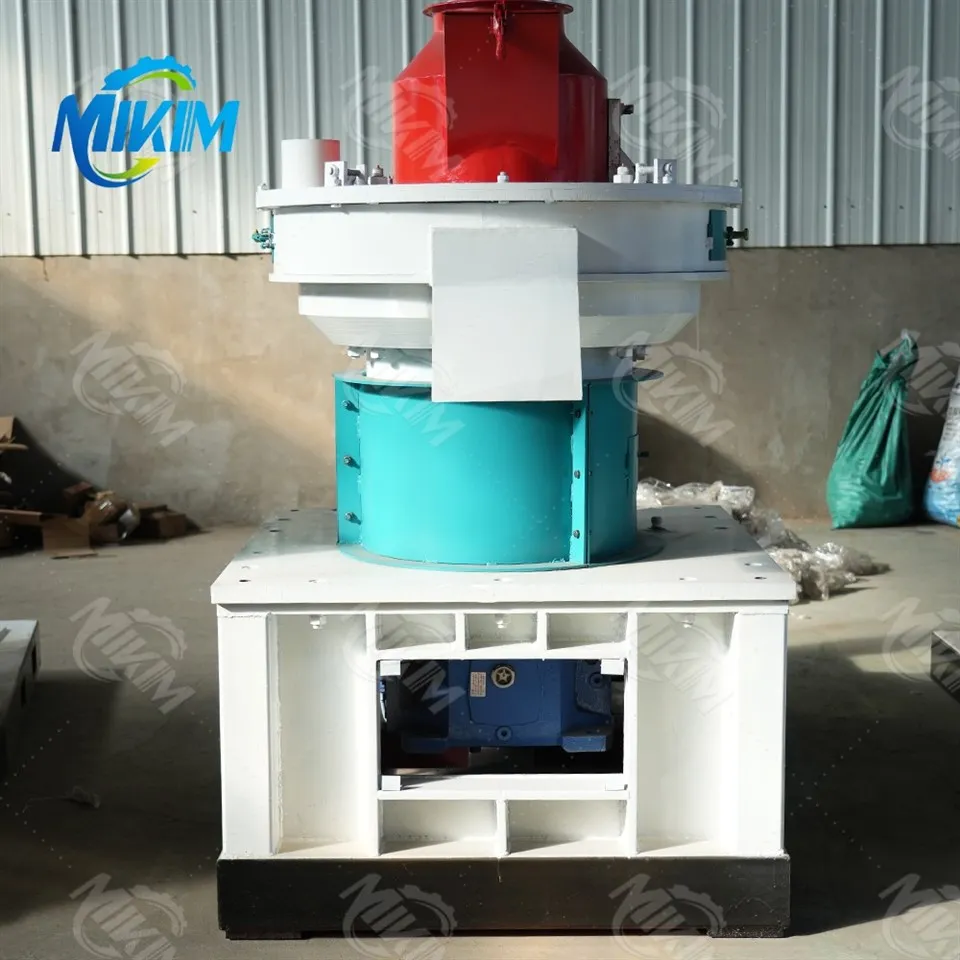
The smallest frame in the range is rated 1-1.5 t/h on a 90 kW drive and takes die holes from 4 to 12 mm; the other three step to 132, 160 and 250 kW. All four share the 4-12 mm die range, so the die decision does not follow frame size, and a site that later buys a larger frame keeps its die stock.
Reference
the PFI Standards Program for graded fuel pellets sets the grading language this die order is written against.Related
the ring die wood pellet machine range sets the four frames beside their die and roller options, and the 300-500 kg/h small flat die biofuel line is the smaller route if the line stays flat die and sawdust only.How to read a derated duty point
For a 500 kg/h target the smallest frame is the only proportionate purchase. The next frame up is rated 1.5-2 t/h on 132 kW, a third more at the top of the band and 47% more motor than a 500 kg/h duty asks for. Running below the rated band is a normal engineering choice, and it is described as one here.
Read the duty point as a fraction. 500 kg/h against a rated band of 1,000-1,500 kg/h is 33% to 50% of rating, and 40% at the middle. Everything downstream, from cooler to bagger, is then sized on 500 kg/h rather than on the 1.5 t/h top of the frame band; a site that plans the whole line at 1.5 t/h pays for a cooler, a sieve and a bagger it never fills.
Two die diameters belong in the order because the order is for 6 mm and 8 mm, and each takes its own die set, since a die cannot be re-bored to another hole size in service. The 6 mm die passes less material than the 8 mm die on the same frame, so the 6 mm duty is the lower figure and the one to use when the guarantee is written. Logistics follow the table: 2620 x 1640 x 1770 mm and 5.2 t set the lifting plan and foundation footprint.
04
Why Does a 1-1.5 t/h Frame Run Safely at 500 kg/h?
The decision rule for motor load at 500 kg/h
Divide the target by the middle of the rated band: 500 divided by 1,250 is 40%. A 90 kW drive at 40% of rated throughput draws well below nameplate current, and the die chamber, main shaft and gearbox work below design load. The frame is asked to do well under half of what it was built for.
Reference
the IEA Bioenergy research programme publishes the conversion and energy balance work behind the kWh per tonne figures used here.Derating is set by two adjustments, not by fitting a smaller motor. Ring die is specified rather than another die type at this duty because the die stays fixed while the rollers run inside it, so a throttled feed still loads the whole die face and density does not drift when the feeder is turned down. The forced feeder is throttled so material is metered in at a steady rate, and the die compression ratio is chosen for hardwood rather than for maximum tonnage. Both adjustments are mechanical and reversible.
Related
a one tonne per hour biomass pellet line build shows the same frame close to its rated band, which is the reference point for a site that expects to grow.Die hole range 4-12 mm against 6-8 mm
The range covers the 6 mm and 8 mm request with margin. Hole size alone does not fix output, because open area, compression length and roller clearance act together, which is why the two die sets are quoted as separate items.
Three gains come with the derated duty. Pellet density holds steadier because the feeder is not fighting the die for material. Die temperature stays inside a workable band because the energy going into the die per hour is lower. Die and roller wear spread more evenly across the working face. No hour count is claimed for any of them.
One cost comes with the same duty. Specific energy, meaning kWh per tonne, is worse at 40% load than at 80-90%, because the drive, the gearbox and the auxiliary motors carry their losses whether or not the die is full. That belongs in the quotation as a stated figure rather than in the first electricity bill. Measured values for both die sizes are to be confirmed at the trial run, with sample weight, die used and moisture on the test sheet.
05
Which Pulveriser Accepts Chips From 1 mm to 7 cm Long?
Max feed size 15-45 cm against a 7 cm chip
The chips in this enquiry are irregular: 1 mm to 7 cm long and 1-2 cm wide, dry and hard, out of a crusher that already exists on site. The longest piece is 7 cm and every frame opens at 15 cm or more, so the widest piece is between 16% and 47% of the smallest and largest openings.
Model
Power
Capacity
Max feed size
7 cm piece against the opening
Overall size
Weight
MK-420
7.5 kW
600-1000 kg/h
15 cm
47% of opening; accepted
1.4 x 0.8 x 1 m
240 kg
MK-600
30 kW
2000 kg/h
20 cm
35% of opening; accepted
1.6 x 0.8 x 1.1 m
520 kg
MK-800
37 kW
3000 kg/h
25 cm
28% of opening; accepted
1.8 x 0.9 x 1.2 m
670 kg
MK-1000
75 kW
5000 kg/h
35 cm
20% of opening; accepted
2.2 x 1.3 x 1.4 m
1500 kg
MK-1200
90 kW
6000 kg/h
40 cm
18% of opening; accepted
2.4 x 1.4 x 1.5 m
2000 kg
MK-1500
110 kW
8000 kg/h
45 cm
16% of opening; accepted
2.6 x 1.5 x 1.6 m
2500 kg
No second coarse crushing stage is required for a 7 cm chip on any of the six frames. The table says nothing about throughput, which is the next decision.


Related
the wood pulveriser and shaving maker page shows the same six frames with their inlet arrangements.The decision rule for pulveriser throughput
Match the pulveriser to the hours it runs, not to the press rating. A 600-1000 kg/h frame covers a 500 kg/h press duty only if grinding runs about half an hour longer than pressing for every hour of production. A 2,000 kg/h frame runs in step with the press and absorbs the surge when a load of chips arrives and the line has to catch up.
The rule is arithmetic. Multiply press rate by press hours, divide by the pulveriser hours available, and add 20% for the difference between chip feed and ground output. A five hour day at 500 kg/h is 2,500 kg of pellets, and grinding that in four hours requires a little over 600 kg/h of ground material, which the smallest frame holds at the top of its band.
Two items stay open. Ground fineness at the pulveriser outlet is to be confirmed against the factory technical confirmation sheet, because the die has its own inlet requirement. The existing crusher stays in scope as the front section, so the pulveriser only carries the chip to powder step.
06
What Bag Width and Seal Method Fit a 15 kg PVC Bag?
The decision rule for bag width and weight
The bagging scale weighs 10-50 kg at 260-300 bags per hour, holds static accuracy of +/-0.1% and dynamic accuracy of +/-0.2%, takes air at 0.6-0.8 MPa and 0.2 Nm3/min, measures 1200 x 1200 x 2400 mm and runs on a 3 kW supply. The bag data in the enquiry, a width of 3-15 cm and a height of 40 cm, is a shape description rather than a specification.
The clarification is the difference between flat width and filled width. A PVC bag of 3-15 cm flat width opens to a pillow or gusset section wider than that figure, and 15 kg of pellets occupies a volume fixed by bulk density. The judgement is a fill test: fill three sample bags with 15 kg of finished pellet, measure filled width, depth and height, then compare those numbers with the clamp opening and the bag length the bagger can hold. A filled section wider than the clamp means the bag type does not suit the scale; a filled height past 40 cm means the bag is short for the weight.
Sealing options: sewing versus heat sealing
The standard unit closes bags by sewing, with an automatic weighing head, a conveyor, the sewing head and computer control in one package. A horizontal heat seal is not part of that package, so , mounted at the end of the bag conveyor with its own air and power demand.
The conveyor point sets the layout. Bags travel from the weighing head on a belt, and the closing station sits far enough downstream for the bag to settle. At 260-300 bags per hour the interval between bags is 12 to 14 seconds, so conveyor length and sealing cycle are chosen together.
A PVC bag also has to be matched to the seal bar before the station is specified: sealing temperature, dwell time and film thickness come from the bag supplier's data sheet, and a film too thin for the dwell time seals and then splits at the fold. The 3 kW rating and the air demand both change when a sealing station is added, so the connected power total here is stated without the sealer. The bag count is quoted as 260-300, while one parameter list shows 200-300 for the same unit; the figure is taken as 260-300 subject to factory confirmation.
07
Which Connection Points Decide Fit With the Machines Already on Site?
Five interface bands: power, height, discharge, dust, control
A retrofit fails at the joints far more often than at the machines. Five points carry almost all of the risk: electrical supply, inlet height of each unit, discharge drop between units, dust pick-up points and the control interface. Each is a measurement the site can take in an hour.
Point
What is fixed on our side
What the site has to confirm
Supply voltage and frequency
Bagging scale rated 380 V 50 Hz +/-2%
Site voltage, phase count, and whether a transformer upgrade is planned
Motor starting
Direct on line or star-delta per motor size
Whether a variable drive is wanted on the pulveriser
Inlet height
Pulveriser inlet height and connection flange
Discharge height of the existing conveyor
Discharge and drop
Press outlet height and chute geometry
Cooler inlet height and horizontal offset
Dust pick-up
Hood at pulveriser outlet and press inlet
Duct diameter and spare fan capacity
Control and interlock
Local panel per machine, run and stop signals
Whether one group emergency stop is required


Next step
send voltage, inlet height and chip size for a retrofit check and the interface table comes back with the four machines placed against the existing layout.
How to judge a match before shipment
The test is whether every row has a number in the site column before the order is placed. A row left as a range or a guess becomes a site modification, and that turns a machine purchase into a construction project.
Height is the most common surprise. A press inlet set for a screw feeder at one level will not take a belt discharger at another, and the difference is absorbed by a chute fabricated on site. Discharge drop is the second: too little fall blocks the chute, too much breaks pellets on impact.
Power is the third. The bagging scale is rated for 380 V 50 Hz +/-2%, while the motors on pulveriser and press are wound to the site supply, so a site running another voltage or frequency has the winding agreed before manufacture. That value, with transformer capacity and cable size, is to be confirmed against the factory technical confirmation sheet.
08
Which Wear Parts Belong in the First Spare Order?
The decision rule for a first spare set
The enquiry asks for dies, one set of rollers and whatever else is recommended. The rule used here is one full consumable change per item on the shelf from day one, plus the small parts that stop a line when they fail. That keeps a single breakdown from becoming a two week outage without tying up money in parts that may never be used.
Item
Quantity in the first order
Replacement criterion
Ring die, 6 mm hole
1 set
Pellet diameter or density drifting outside the agreed sample, judged per die
Ring die, 8 mm hole
1 set
Same criterion, applied to the 8 mm duty
Roller assembly, complete
1 set
Uneven track on the die face or shell wear past the limit
Roller shaft bearings
1 set per roller
Temperature or vibration trend at the roller shaft
Shaft seals and O-rings
1 set
Leak at the die chamber or the gearbox joint
Drive belts
1 set
Tension loss beyond the adjustment range
Die clamp bolts and shear pins
1 set
Any deformation after a jam
Related
the wood pellet mill category lists die and roller options across the press families, which is where a second die order is placed.One die set per pellet diameter
Two die sets belong in the first order rather than one, because the customer ordered 6 mm and 8 mm pellets and each diameter takes its own die. Holding both lets the line switch diameter on the day the order book changes.
Die life is set by material hardness, compression ratio and hours run, so no hours figure is quoted here. The site keeps its own record: the date a die goes in, the tonnage passed, and the point at which the pellet sample stops matching the reference. A single shift site at 500 kg/h passes about 1,000 tonnes in 250 working days, so the first year of spares is sized on those running hours rather than on a fixed package.
9
How Much Connected Power Do the Four Supplied Machines Add?
Per unit power band for four machines
The four supplied items draw power on very different scales, and the press dominates the total:
- Ring die press on the smallest frame: 90 kW - Pulveriser, smallest frame: 7.5 kW, or the 2,000 kg/h frame at 30 kW - Bagging scale: 3 kW - Infeed conveyor: 1.5 kW
With the smallest pulveriser the total is 102 kW. With the 2,000 kg/h pulveriser it is 124.5 kW. Both figures are , taken from nameplate ratings, and both exclude dust collection, compressed air and everything already on site.
The decision rule for the total
Use the higher figure for the electrical plan and the lower one for the operating estimate. A supply sized on 102 kW will not start the 124.5 kW configuration, and a supply sized on 124.5 kW costs more than the site requires if the smaller pulveriser is chosen. The 22.5 kW between them is the pulveriser decision, not a rounding error.
Presses in the 100-300 kg/h band are 15, 22 and 30 kW machines, so the retrofit adds roughly 90 kW of drive capacity in one step. That step triggers a transformer review, and it belongs before the order.
Three items sit outside the total: the dust collection fan, the compressed air supply at 0.6-0.8 MPa and 0.2 Nm3/min for the bagger, and any conveyor extension between pulveriser and press. Transformer capacity and incoming cable size are to be confirmed against the factory technical confirmation sheet.
10
How Are Lead Time and Quotation Scope Stated for a Retrofit?
The decision rule for a retrofit quotation
A retrofit scope for a 500kg/h ring die biomass pellet line is issued as an itemised quotation, EXW/FOB basis; CIF or CFR available on request. The itemisation is the point: four host machines, the interface parts that join them to the existing line, the first spare set, export packing and the technical file each appear as their own line, so the site can add or drop a section without renegotiating the order.
The technical file holds the general arrangement drawing, the utility schedule, the die and roller list and the confirmation sheet with its lubrication line item. Where a value is still open the sheet says so rather than leaving a blank.
Related
ask for an itemised retrofit quotation with the interface values attached, and the four machines are quoted against the site rather than against a catalogue list.Lead time counted from deposit
Lead time runs from receipt of the deposit and approval of the drawings, not from the enquiry date, and the days are stated per line in the quotation. Two events sit inside that window: drawing approval, which depends on interface values coming back from site, and the factory test, where the 500 kg/h discharge figure is demonstrated.
The test belongs in the contract. A timed run on the 8 mm die, a weighed sample, the moisture of the incoming material and the die compression ratio go on the test sheet, with the same readings on the 6 mm die. Pre-shipment acceptance compares that sheet with the figures agreed at order stage.
Installation, commissioning and operator training are quoted separately, so a site with its own fitters takes the machines only. Payment terms, warranty length and port of loading are to be confirmed against the factory technical confirmation sheet.
FAQ
FAQ: 500 kg/h Ring Die Retrofit on a Running Sawdust Line
1
What does a 500 kg/h ring die upgrade replace on a 100-200 kg/h wood fuel pellet making line?
Four items: a ring die press on a 90 kW frame rated 1-1.5 t/h, a chip pulveriser, a 15 kg bagging scale and a first spare set. The existing crusher, hopper, most conveying and the dust ducting normally stay. Cooler and sieve stay only where rated at 500 kg/h or above.
2
Why is a 1-1.5 t/h ring die frame used for only 500 kg/h vertical ring die pellet line?
500 kg/h against a rated band of 1,000-1,500 kg/h is 33% to 50% of rating, so the frame runs as a derated duty. The next frame up is rated 1.5-2 t/h on 132 kW, a third more at the top of the band and 47% more motor. Gains are steadier density, controlled die temperature and more even wear; the cost is a higher kWh per tonne than at 80-90% load.
3
Does the Ring die biomass sawdust pellet machine include automatic central lubrication?
Not as a stated item. The wood chip ring die range carries no central lubrication entry, so the requirement is recorded as to be confirmed against the factory technical confirmation sheet, with pump type, lubrication points and grease specification if the answer is yes. The feed ring die family states a fully automatic lubrication system in its feature list, but that is a different product family.
4
Which pulveriser accepts wood chips 7 cm long?
All six frames do, because the maximum feed opening runs from 15 cm to 45 cm, so a 7 cm chip is 16% to 47% of the opening. Throughput decides the choice: a 600-1000 kg/h frame at 7.5 kW covers 500 kg/h only if grinding runs about half an hour longer per production hour, while a 2,000 kg/h frame at 30 kW runs in step with the press.
5
Can a 15 kg PVC bag be heat sealed on the bagging machine?
Not on the standard unit, which closes bags by sewing. A horizontal heat-sealing station is quoted separately and confirmed per project, mounted downstream on the bag conveyor with its own air and power demand. The bag data also calls for one clarification: a 3-15 cm width with a 40 cm height has to be matched to 15 kg by a fill test on three sample bags.
6
What connected power do the four replacement machines add?
The press adds 90 kW, the bagging scale 3 kW and the infeed conveyor 1.5 kW, so the pulveriser decides the total. With the smallest pulveriser at 7.5 kW the figure is 102 kW; with the 2,000 kg/h pulveriser at 30 kW it is 124.5 kW. Both totals are Illustrative, taken from nameplate ratings, and exclude dust collection and compressed air.
Hot Tags: 500 kg/h Ring Die Biomass Pellet Line, China 500 kg/h Ring Die Biomass Pellet Line manufacturers, suppliers, factory, wood pellet production schedule, Small pellet production line, Complete Wood Pellet Line, wood pellet quality control in production, homemade sawdust pellet line, pellet machine line
Previous:
You Might Also Like


Send Inquiry
