

Products


700kg/h Biomass Pelletizing Line
700kg/h Biomass Pelletizing Line: Full Equipment List, Installed Power and Electricity per Tonne
Features
Quick answer
A 700kg/h biomass pelletizing line is a complete station chain - crushing, conveying, pelleting, cooling, sieving and packing - sized so that the press runs at 700 kg per hour on a well prepared wood or biomass feed, with the flat die frame rated 500-800 kg/h on a 55 kW drive as the standard press and a ring die press rated 1-1.5 t/h on a 90 kW drive as the upper option.
▪
Illustrative total installed power for the flat die configuration without a dryer is about 109.6 kW; with a drying station the total is to be confirmed against the factory technical confirmation sheet.
▪
Electricity per tonne: 55 kW divided by 0.7 t/h gives about 78.6 kWh per tonne for the press section alone (Illustrative); auxiliary stations and drying are counted separately.
▪
A complete line contains a crushing station, transfer conveyors, a press station, a cooling station, a sieving station and a packing station, with drying added when incoming moisture is high.
▪
The press inlet moisture window for wood biomass is confirmed per project; drum dryers in this class are specified to an outlet of about 15 percent moisture.
▪
The quotation basis is an itemised quotation, EXW/FOB basis; CIF available on request.
Rated capacity and installed power are two different numbers on a 700kg/h biomass pelletizing line, and treating them as one is the most common planning error at this output. The line sits between a small workshop build and a full industrial plant, and at that level the answers follow the whole station chain rather than the press alone. The sections below set out the complete equipment list for a 700 kg/h wood and biomass line: the rated capacity of each press option, the per machine power draw, the total installed power, and an illustrative electricity figure per tonne of wood pellets. The incoming moisture window the press accepts is covered as well.
1.5-2 t/h Ring die biomass pellet making machine testing
01
How Is 700 kg/h wood fuel pellet making line Rated Capacity Actually Defined?
A rated capacity of 700 kg per hour describes the press station, measured on a defined feedstock at a defined moisture level. It is not a promise that every load leaves the die at 700 kg per hour. The press responds to the material in front of it: fibre length, moisture, bulk density and the share of fines all change the rate at which material passes through the die.
Related
the 1 t/h large biomass pellet line shows how the same station chain is scaled for the tonne per hour class above this duty.Two press families cover this duty, one flat die and one ring die, and both are quoted as a band rather than a fixed point. A frame that reaches the top of its range on a dry, evenly ground feed sits near the bottom of the same range on a wet or coarse feed.
How to judge a rated capacity figure
Read the rating against the feedstock condition, not against the headline number. A frame rated 500-800 kg/h reaches 700 kg/h on a dry, evenly ground wood feed and falls toward the lower end of its band when the feed is wet, coarse or high in fines. Capacity follows die area and drive power, and the band assumes the stations around the press hold a steady supply.
The capacity band of the press options
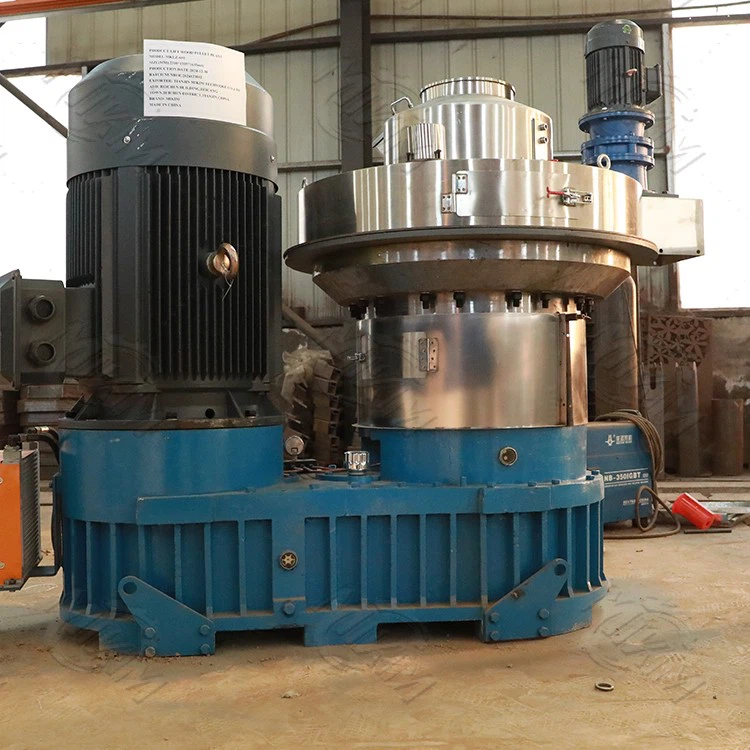
The press options that cover 700 kg/h are the flat die frame rated 500-800 kg/h on a 55 kW drive and the ring die press rated 1-1.5 t/h on a 90 kW drive. The flat die frame sits on the duty directly, with headroom at the top. The ring die press is the upper option and fits a site that expects to grow past 700 kg/h. Actual output varies with feedstock and load and is fixed by test run data rather than by the catalogue figure.

02
What Incoming Moisture Window Does Wood Biomass Tolerate?
Moisture decides whether the press can grip the feed and form a pellet at all. Wood and biomass arrive across a wide range, from kiln dry sawdust to green chips straight from a chipper, and the press forms a firm pellet only inside a narrow band of that range.
The incoming moisture band before the press
The dryer side of the same calculation is recorded and is useful as a reference point: drum dryers in this class are specified to bring material down to an outlet of about 15 percent moisture. That is a dryer outlet target, not the press inlet window. At the wet end, moisture sits between die and roller, the material slides instead of being pressed, and the die holes fill with paste and stop taking material. At the dry end, friction and temperature rise, the pellet surface glazes and the core stays weak.
What decides whether a dryer is added
The decision turns on where the water enters the stream. When one wet component is dragged down by dry material, blending can bring the average into the window and no dryer is required. When the whole incoming stream sits above the window, blending cannot lower the average and a drying station belongs in the line. Test moisture at intake, after grinding and after drying, because wood biomass does not release water evenly through a pile.
03
Which Machines Run in Sequence to Reach 700 kg/h?
A 700 kg/h line is a sequence of stations, each doing one job and each sized above the press that follows it, so that no single unit becomes the bottleneck.
Related
the wood pellet production line hub places this station chain beside the larger builds that share the same process logic.
Transfer between stations is handled by screw conveyors with hoppers for short level runs and by belt conveyors for longer runs. A bucket elevator is used where material has to be lifted to the top of a bin. A control panel ties the drives together and sets the interlock order.
Reference
the pellet machine product range lists the die frames that sit in the press station of this chain.The selection logic for the process chain
The chain is the same at every output: crushing, conveying, pelleting, cooling, sieving, packing. Each station is sized from the press outwards. The press sets the duty at 700 kg/h. Crushing and conveying are set above it so they keep the press fed; cooling, sieving and packing are set at or just above the press rate so pellets never pile up hot between the cooler and the packer.

The station by station capacity band
The table below gives the drive and the rate for each station of the illustrative flat die configuration.
Process step
Equipment
Model band
Power
Capacity
Crushing
Wood crusher
MK-600
30 kW
2000 kg/h
Transfer
Screw conveyor with hopper
KWX75YP
3 kW
up to 2000 kg/h
Transfer
Belt conveyor
KWQB380
2.2 kW
matched to the line
Transfer
Bucket elevator
TDSG10-16 to TDSG10-33
0.75-7.5 kW
matched to the line
Pelleting, standard
Flat die press
RKL-450
55 kW
500-800 kg/h
Pelleting, upper option
Ring die press
MKLH560
90 kW
1-1.5 t/h
Cooling
Counter flow cooler
NKSL11x11
5.5 kW drive + 2.1 kW fan
1000-3000 kg/h
Sieving
Cooling and sieving unit
LX-LS50
8 kW
800-1000 kg/h
Packing
Automatic quantitative packer
DCS-Z-W-50
3 kW
10-50 kg, 260-300 bags/h
Drying when required
Drum dryer
0.8 x 8 m to 1.0 x 10 m
4.0 + 7.5 kW to 7.5 + 7.5 kW
confirmed per project
Drying is listed apart from the main chain because it is not part of every line. It is fitted when the incoming feedstock is above the press window, and it changes both the power total and the building footprint, so it is quoted as a separate scope.
04
How Much Total Connected Power Does the Full Line Draw?
Total connected power, also called installed power, is the sum of the nameplate ratings of every drive in the line. It decides the incoming supply, the cable and switchgear sizes and whether a generator is required, so it is one of the first figures a buyer should obtain.
The final total is to be confirmed against the factory technical confirmation sheet, because it changes with conveyor lengths and the number of transfer points.
The per machine power band
The drives in this class run from a 2.2 kW belt conveyor up to the 55 kW press drive, with a 90 kW ring die press as the upper option. The table below is the illustrative configuration used for the total.
Line section
Drives in section
Section power
Notes
Crushing
1 crusher drive
30 kW
single drive, sized above the press
Transfer
Screw conveyor, belt conveyor, bucket elevator
3 kW + 2.2 kW + 0.75 kW = 5.95 kW
varies with run length and lift height
Pelleting
1 press drive
55 kW
ring die option raises this to 90 kW
Cooling
Cooler drive and fan
5.5 kW + 2.1 kW = 7.6 kW
drive and forced draught fan
Sieving
Cooling and sieving unit
8 kW
combined unit
Packing
Automatic quantitative packer
3 kW
compressed air supply counted separately
Illustrative total, no dryer
-
109.55 kW
flat die configuration
Drying when required
Drum dryer
4.0 kW + 7.5 kW and above
separate station, quoted per project

How to judge the installed power total
Add every drive, then separate the stations that run continuously from the ones that run intermittently. The press, the crusher and the cooler fan run through the shift; the packer and some conveyors cycle. Design the incoming supply on the arithmetic sum, because switchgear is sized on connected load rather than on average draw.
05
How Do You Estimate Electricity Use per Tonne of Pellets?
Electricity per tonne is estimated by dividing a station's installed power by the throughput it serves, which gives kilowatt hours per tonne at full load. The result is a planning figure rather than a meter reading, because drives rarely run at nameplate at the same moment.
How to judge the electricity figure per tonne
Start from the press, the largest single load and the unit that sets the duty. The press drive rated 55 kW on a duty of 0.7 t/h gives about 78.6 kWh per tonne for the forming step alone. Add the auxiliary stations on the same basis. The full line connected power of about 109.6 kW divided by 0.7 t/h gives about 156.6 kWh per tonne, based on the rounded 109.6 kW total, as an upper planning figure at full connected load. Drying is counted separately. Note the shape of the arithmetic: dividing connected power by capacity overstates real consumption, because not every drive runs at nameplate at once, so treat both numbers as Illustrative upper figures. Actual consumption varies with feedstock and load, and the figure to design against is the test run data for the specific blend. The U.S. EIA explanation of biomass energy covers the same conversion chain, and the arithmetic here accounts for the electrical part of it only.
The load factor band
The load factor is the ratio of real draw to installed power across a shift, and it is the correction that turns a connected power figure into a consumption figure. For this class of line the load factor band is to be confirmed against the factory technical confirmation sheet and is best measured at the test run.
06
Which Press Type Holds 700 kg/h: Flat Die or ring die biomass fuel Pellet making Machine?
Both press families cover 700 kg/h, so the choice is not about which type reaches the duty but about maintenance, pellet density and how far the site expects to grow.
Related
the ring die wood pellet machine range sets the industrial ring die frames beside each other before the press decision is fixed.How to judge the press choice
Choose the Flat Die biomass sawdust pellet machine frame when the target sits inside its band, when the operating team is small, and when the site wants simple maintenance and a lower entry cost. Choose the ring die press when the site expects to pass 700 kg/h in the first operating period. It also fits when a denser pellet is required for handling and storage, or when the line runs long continuous shifts on a uniform feedstock. Neither choice changes the rest of the chain, which is sized on the press rate either way.
The capacity band per press type
Frame family
Model
Capacity
Power
Flat die
RKL-250
100-200 kg/h
15 kW
Flat die
RKL-300
150-250 kg/h
22 kW
Flat die
RKL-350
100-300 kg/h
30 kW
Flat die
RKL-400
300-600 kg/h
37 kW
Flat die
RKL-450
500-800 kg/h
55 kW
Flat die
RKL-550
1000-1500 kg/h
90 kW
Ring die
MKLH560
1-1.5 t/h
90 kW
Ring die
MKLH560A
1.5-2 t/h
132 kW
Ring die
MKLH700
2-2.5 t/h
160 kW
Ring die
MKLH860A
3-4 t/h
250 kW
Read the table by the capacity column. The duty of 700 kg/h falls inside the flat die frame rated 500-800 kg/h on a 55 kW drive. Only the first ring die frame reaches down to the tonne per hour class, so the ring die route starts one step above the flat die route in cost and in footprint.



07
Why Do Cooling and Sieving Decide Final Pellet Quality?
Pellets leave the die hot and soft, and they harden as they cool. When they are packed before they cool, the bag traps heat and moisture, and the pellets swell, deform and grow a dusty surface in store.
Related
the Indonesia biomass pellet line project layout shows where the cooling, sieving and packing stations sit in a full plant arrangement.The cooling capacity band
Counter flow coolers in this class are built in two sizes: a unit rated 1000-3000 kg/h and a larger unit rated 2000-5000 kg/h. Both sit above a 700 kg/h press, so the duty is covered with margin. Horizontal coolers in the same range are rated 250-350 kg/h and 300-500 kg/h and suit smaller lines. The cooling and sieving unit matched to 700 kg/h is rated 800-1000 kg/h on an 8 kW drive and combines the two jobs in one frame.

The decision rule for cooler selection
Size the cooler on the highest rate the press can produce, not on the nominal figure, because a press running at the top of its band produces more than its average. Then check dwell time: pellets require enough time in the cooler to reach handling temperature. Counter flow design is the standard choice because air meets the pellets in the opposite direction to their travel. After cooling, sieving removes fines and oversize crumb before packing, and the fines return to the press.
08
How Should Packing and Finished Product Storage Be Arranged?
Packing is the station where the line meets the market, and its throughput has to match the press so that pellets do not back up behind the cooler. Bag sizes and the storage format follow the same logic as the ENplus wood pellet quality certification scheme, which sets pellet classes for domestic stoves apart from those for larger boilers.
The decision rule for the packing station
Match the packer to the press rate and to the bag the market wants. The automatic quantitative packer in this class fills bags from 10 kg to 50 kg at 260-300 bags per hour on a 3 kW drive. Weighing accuracy is about +/- 0.1 percent static and +/- 0.2 percent dynamic. A 700 kg/h press fills about fourteen 50 kg bags or about twenty eight 25 kg bags in an hour, which sits well inside the packer rating. That gap is deliberate: the machine is sized for small retail bags and for a later output increase, not for fourteen large bags an hour. Set the bag weight from the market rather than from the machine: retail fuel bags for household stoves are usually in the 10-25 kg range.
The bagging throughput band
The packer is rated 260-300 bags per hour over a weighing range of 10 kg to 50 kg, so the throughput band covers every bag size in the range. A compressed air supply of about 0.6-0.8 MPa at roughly 0.2 Nm3/min is required for the weighing and discharge cycle. Store volume, pallet layout and loading access are confirmed per project.
09
What Raw Material Preparation Reduces Load on the Line?
Preparation in front of the press decides how hard the whole line works. Evenly sized, evenly dry feed presses at the rated rate, while uneven feed raises the drive load and lowers output.
The selection logic for upstream preparation
Prepare the feed to one size class and one moisture level before it reaches the press. Reduce oversize material before the press rather than at it: wood chips and offcuts are chipped or crushed first, and only fine material reaches the die. Remove metal and stone ahead of the press, because a single piece of tramp metal can damage a die and stop the line. Between the crushing station and the press, a buffer bin keeps the feed even and stops short loads from reaching the die.
The feed size band
The crushing station in this class is rated 2000 kg/h on a 30 kW drive and accepts feed up to 20 cm. Hammer mills in the range handle softer material at 250-2000 kg/h on drives from 7.5 kW to 45 kW. Set the crushing station above the press rate so the press is never starved. Hold the output fineness consistent, because oversized particles fail to bind in the die while fine dust compacts in the die channels.
10
What Do Acceptance, Warranty and Spare Part Terms Cover?
Commercial terms belong to the configuration, and they are best fixed before the machine list is confirmed, because they decide what stands inside the price basis.
Send the feedstock, the measured moisture and the target output to request a 700 kg/h line configuration, and the commercial terms are quoted against that configuration rather than against a catalogue list.
The decision rule for acceptance
Accept the line on test run data rather than on the catalogue rating. The standard sequence is a single machine no load test, then a linked no load test, then a loaded test run on the actual feedstock. The output, pellet appearance and drive load recorded at that run become the acceptance figures. Before the test run, confirm that the incoming supply matches the motors and controls that were ordered, because a voltage or frequency mismatch found on site is the most common delay in commissioning.
The warranty window
The standard warranty for a line of this class is one year, excluding wear parts, which covers the die, the rollers and any item that wears with use. Payment terms are 30 percent deposit with the balance before shipment, and the lead time is 25-35 days from receipt of the deposit. Every machine, the control panel, the export packing and the freight scope are listed separately, so the buyer can see what the figures cover. No unit prices or totals are published on this page. Spare parts are quoted as a separate list.
11
Where Does Commissioning Start After the Line Arrives?
Commissioning starts before the first motor turns, with the supply and the foundations. A line wired to the wrong voltage cannot be tested, and the fault is found only after the machines are in position.
Before the supply is confirmed, request a feedstock moisture check for a 700 kg/h line, because a measured moisture range for the actual feedstock is the single input that changes the configuration most.
What decides the commissioning order
Follow the same order every time. Verify the incoming supply against the ordered motors and controls, check the foundations and the level of each frame, run each machine unloaded, then run the line linked and unloaded, and only then run it with feed. The loaded test run is where the press rate, the die gap and the moisture target are set for that feedstock. Site work also includes the crushing bay, the drying bay when fitted, the finished product store and the loading access, all confirmed on the factory technical confirmation sheet.
The testing sequence band
The testing sequence runs from the least to the most demanding condition, so a fault is found before it can damage the die. Start with single machine checks, then linked no load checks, then a gradual feed at an increasing rate, then a steady run at the target rate, and finish with a stop and restart cycle to confirm the interlocks.
Three questions that buyers ask at this stage can be answered directly. , covering crushing, pelleting, cooling, sieving and packing for wood and biomass fuel pellets. Reference contacts are provided with the customer's consent, case by case. The technical specification sheet, project photographs and a running video can be provided project by project on request.
FAQ
FAQ: 700 kg/h Biomass Pelletizing Line Configuration and Power
1
How many kilowatts does a 700 kg/h biomass pelletizing line draw in total?
For the flat die configuration without a dryer, an illustrative total installed power is about 109.6 kW: a 30 kW crusher, about 5.95 kW of conveying drives, a 55 kW press, 7.6 kW of counter flow cooling, 8 kW of cooling and sieving, and a 3 kW packer. Choosing the ring die press option raises the press drive to 90 kW. A drying station is counted separately and can add 4.0 kW plus 7.5 kW and above. The final figures are issued with the technical confirmation sheet.
2
How much electricity is used per tonne of wood pellets?
Divide a station's power by the throughput it serves. The press drive rated 55 kW on a 0.7 t/h duty gives about 78.6 kWh per tonne for the forming step alone, as an Illustrative figure. The full line connected power of about 109.6 kW divided by 0.7 t/h gives about 156.6 kWh per tonne, as an Illustrative upper planning figure at full connected load and based on the rounded 109.6 kW total. Actual consumption varies with feedstock and load and is fixed by test run data.
3
What moisture content can wood biomass enter the press at?
The press inlet moisture window for wood biomass is to be confirmed against the factory technical confirmation sheet, and it is best fixed by a test run on the actual feedstock. Above the window the feed slides between die and roller and output collapses; below it friction and temperature rise and the pellet core stays weak. The dryer side is recorded: drum dryers in this class are specified to an outlet of about 15 percent moisture.
4
Which machines form a complete 700 kg/h biomass pelletizing line?
A complete line adds a crushing station rated 2000 kg/h on a 30 kW drive and transfer conveyors. The press station is rated 500-800 kg/h on a 55 kW drive, followed by a counter flow cooler rated 1000-3000 kg/h with a 5.5 kW drive and a 2.1 kW fan. A cooling and sieving unit rated 800-1000 kg/h on an 8 kW drive precedes an automatic quantitative packer rated 260-300 bags per hour on a 3 kW drive filling 10-50 kg bags.
5
Is a flat die or ring die biomass pellet making machine better for 700 kg/h?
Both cover the duty. The flat die frame rated 500-800 kg/h on a 55 kW drive holds 700 kg/h with headroom and suits a small operating team, simple maintenance and a lower entry cost. The ring die press rated 1-1.5 t/h on a 90 kW drive fits a site that expects to grow past 700 kg/h, that requires a denser pellet, or that runs long continuous shifts on a uniform feedstock.
6
What warranty and payment terms apply to a 700 kg/h wood pellet manufacturing line?
The standard warranty is one year, excluding wear parts such as the die and the rollers. Payment terms are 30 percent deposit with the balance before shipment, and the lead time is 25-35 days from receipt of the deposit. The quotation basis is an itemised quotation, EXW/FOB basis; CIF available on request, with every machine, the control panel, export packing and the freight scope listed separately.


Hot Tags: 700kg/h Biomass Pelletizing Line, China 700kg/h Biomass Pelletizing Line manufacturers, suppliers, factory, wood pellets machine manufacturing plant, portable wood pellet line, wood pellet production inspection, Movable Mini Pellet Plant, wood pellet production manual, Large biomass pellet production line
Previous:
You Might Also Like


Send Inquiry
