


Why Choosing the biomass wood Pellet machine Is Better Than Traditional Processing
content
In terms of production efficiency, the difference between wood pellet machines and traditional processing methods is extremely significant. Traditional feed processing relies heavily on manual crushing and mixing, with each person handling a maximum of 50 kg of raw materials per day. The process is cumbersome and requires multiple steps. In contrast, a small wood pellet machine can process 0.3 tons of raw materials per hour, achieving a daily processing capacity of 2-3 tons, which is 40-60 times more efficient than manual processing. Even compared to traditional small grinders, pellet machines offer significant advantages. Grinders only crush the raw materials, requiring subsequent mixing and forming processes, while pellet machines achieve integrated "crushing-mixing-forming" production, shortening the process by more than 60%. One feed processing plant increased its daily processing capacity from 0.5 tons to 3 tons and reduced the number of workers from 5 to 2 after replacing its traditional equipment with a wood pellet machine, resulting in a substantial increase in production efficiency.
The stability and superiority of product quality are the core competitiveness of wood pellet machines. Traditional processing methods are heavily influenced by manual operation, leading to uneven raw material particle size and inaccurate mixing ratios, resulting in significant fluctuations in product quality. For example, in feed processed using traditional methods, additives are unevenly distributed, and some feed nutrients are lost. Small biomass wood pellet machines, through their automated control systems, achieve precise control over raw material particle size, mixing ratio, and pressing pressure. The density deviation of the pelleted product does not exceed 5%, and the error in nutrient uniformity is controlled within 3%. In biomass fuel processing, fuel produced by traditional methods is loose and has low combustion efficiency, while wood pellet machines produce high-density fuel with complete combustion, achieving a calorific value of 4200-4800 kcal/kg, far exceeding the 3000-3500 kcal/kg of traditional fuels.
In terms of cost control, industrial wood pellet machines have a significant advantage over traditional methods. Traditional processing methods have high labor costs and significant raw material waste; the labor cost for processing one ton of feed can reach 200-300 yuan, with a raw material waste rate exceeding 10%. The labor cost for processing one ton of feed using a wood pellet machine is only 50-80 yuan, with a raw material waste rate of less than 5%, resulting in savings of over 200 yuan per ton in labor and raw material costs alone. Furthermore, traditional equipment has higher energy consumption and requires multiple machines to operate simultaneously, resulting in a total energy consumption 1.5-2 times that of wood pellet machines. In the long term, wood pellet machines also have lower maintenance costs. Traditional equipment, due to its dispersed structure and numerous vulnerable parts, incurs annual maintenance costs of 10%-15% of the total equipment price, while the maintenance cost of wood pellet machines is only around 5%.
In terms of adaptability and safety, hay pellet machines comprehensively surpass traditional methods. Traditional processing equipment has high requirements for raw materials and can only process specific types and states of raw materials. Wood pellet machines, however, can adapt to a variety of raw materials such as hay, straw, and sawdust, and can process raw materials with a moisture content of 10%-18%, without complex pretreatment. At the same time, wood pellet machines are equipped with overload protection and leakage protection devices, avoiding the safety accidents that are prone to occur with traditional equipment. In summary, wood pellet machines are superior to traditional processing methods in terms of efficiency, quality, and cost, making them the mainstream equipment in the biomass processing field.
biomass wood Pellet machine for sale
Hay pellet mill is a machine to turn hay materials into pellets. Also, it can process other raw materials, such as crop straw, rice husk, grass, alfalfa, leaf, sawdust, and wood chips. It is practicable to mix hays with other materials to improve the nutritive value.
Small hay pellet machine is the flat-die type. It is small and easy to operate, and the machine is suitable for small-scale production such as farmers, home uses, and wood pellet manufacturers. The gearbox of the machine is driven by bevel gear which is made of gray cast iron, with high efficiency, long service life, and low noise.
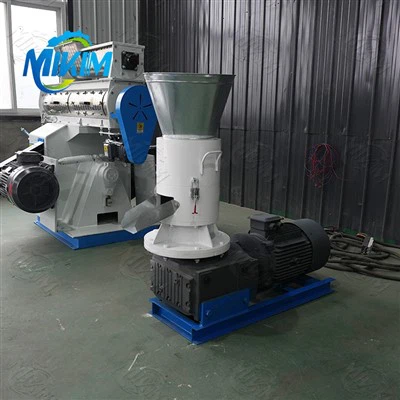

Large hay pellet mill is ring die pellet press. It features large capacity and less power consumption. Generally, large hay pellet machine is more suitable for large farm if for your own use. And it is also more suitable for setting up the pellet production business.


If you don't how to choose the right hay pellet mill, need flat die type or need ring die type. Just tell us your requirements, budget and more detailed information, our professional experts will help you to choose a hay pellet machine that suits you most.
about us
Customer visit

Certificate of Honor

FAQ
1.What is the price of equipment for a Industrial wood pellet machine?
It costs approximately US$1,900.00 - 28,600.00
2. If equipments have some quality problem, how would you deal with?
We will responsible for all the quality problems. Change all the parts for free.
3. What services can we provide?
We have professional overseas installers responsible for installation, commissioning, and free training. Professional personnel are waiting for you online 24 hours a day.


