

Products


2T/h Biomass Briquette Production Line
This 2 tonne per hour Charcoal Bar Production Line is equipped with a carbonisation furnace, adopting a configuration of one forming section matched with one carbonisation section.
Features


01What Does a 2 t/h Biomass Briquette Production Line Including a Carbonisation Furnace Contain?
A 2 t/h biomass briquette production line runs two stages back to back. The first prepares loose biomass and extrudes it into dense round sticks; the second carbonises those sticks into charcoal. Between them sits the decision that decides whether the plant works: how to balance a continuously running forming stage against a furnace that needs a set feed rate and residence time.
Christian's inquiry arrived as three requests in one message: a 2 t/h forming line, the carbonisation furnace included, and two feedstocks with their moisture figures attached. So this page treats forming and carbonisation as one balance problem and answers both cases directly.
1-1.5 t/h Combustible Charcoal Briquette Production Line test in our factory
The forming stage and the carbonisation stage side by side
| Stage | Core equipment | Duty |
|---|---|---|
| Preparation | Crusher plus airflow dryer | Bring feed to a screened size and to the 5%-12% forming window |
| Forming | Wood sawdust stick machines | Screw-extrude feed into binder-free round sticks of 50 mm or 80 mm |
| Carbonisation | Continuous carbonisation furnace | Convert green sticks into mechanical charcoal, using recovered flue gas as the line's own heat |
| Finishing | Char cooler and screening |
Cool the char and grade it before packing |

Why 2 t/h is a line rate, not a single-machine rate
The single-machine ratings in the forming range top out at 300 kg/h, so a 2 t/h line cannot come from one machine. The 2 t/h figure is a line output target the plant reaches by running several stick machines in parallel and pooling their output to the furnace - the number the carbonisation stage must be matched against.
Configuration follows feedstock. Tell us your feedstock and target line rate and we will confirm what fits before you commit to anything.
02Why Are a Wood Sawdust Stick Machine and a Carbonisation Furnace a Natural Pair?
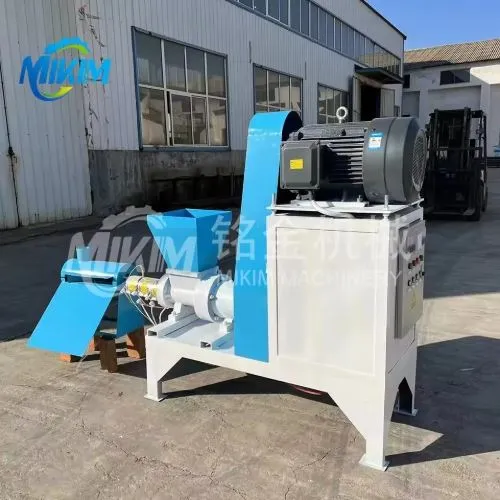
The wood sawdust stick machine - also called a mechanical charcoal machine - and the carbonisation furnace are not two unrelated products sold together by coincidence; they were designed as a pair. The machine's own description says it forms material into sticks that can then be carbonised in a furnace into mechanical charcoal. The forming machine gives the furnace a consistent, dense feed, and the furnace turns that feed into a higher-value product.
That pairing also changes the product sold. A forming line alone sells densified solid fuel by the tonne; a forming line with carbonisation sells charcoal, a different product for a different buyer. The furnace also constrains the machine, needing sticks of even shape and density to carbonise evenly.
What binder-free forming means for the two stages
Binder-free forming makes the pairing clean. The machine relies on screw extrusion through a heated sleeve rather than a glue, so the process takes biomass and nothing else: no starch or resin to buy, store or weigh. A stick that is pure feedstock also leaves no additive residue in the char.
How the furnace turns formed sticks into mechanical charcoal
Inside the furnace the sticks first dry, then lose their volatiles, then convert to carbon. What remains is a fixed-carbon structure - the mechanical charcoal the line is built to make. For a wider view, see the sawdust charcoal making machine range.
03How Does Screw Extrusion Form Binder-Free Round Sticks of 50 mm and 80 mm Diameter?
The forming stage is a screw extrusion machine, not a punch press. A screw assembly pushes prepared feedstock forward under pressure while a heated forming sleeve at the outlet raises its temperature. Under that pressure and heat the natural lignin in the feedstock plasticises and acts as its own binder, so by the time the stick leaves the sleeve it has bonded. The output is a solid round rod - a round stick, not a square briquette.
Four working parts make up the machine: the screw extrusion mechanism, the heated forming sleeve, the feeding system and the transmission system. Around it sit the matching equipment that makes the line work: the crusher, the airflow dryer and the carbonisation furnace.
Screw extrusion, the heated forming sleeve and natural lignin
The heated sleeve does the real work. Heat and pressure make the feedstock bind to itself through the lignin it already contains, so no added binder is needed. Feed moisture also has to sit inside a defined window: above it the sleeve spends its heat on water instead of material, and below it the feed stiffens and flows unevenly.


Why the output is a round stick, not a square briquette
The forming sleeve sets the stick shape, and in this range the sleeves produce a round rod of 50 mm or 80 mm diameter. A round stick feeds a continuous furnace evenly and packs with predictable voids. If your project was specified around square briquettes, note that this line makes round sticks. For the forming side of the family, see the wood sawdust briquette making machine page.
04Why Does a 2 t/h Wood Chip Charcoal Production Line Run 7 to 8 Stick Machines in Parallel Instead of One Large Press?
Two Biomass Rod Brick Press Machine ratings set the count. The larger forming machine is rated 250-300 kg/h on 22 kW, and 2 t/h means 2,000 kg/h of formed stick, so no single machine reaches that rate. So the line reaches it the way any modular plant does - by running several identical units side by side and pooling their output into one feed stream.
Paralleling also buys uptime. With seven or eight units sharing the duty, one can be pulled out for sleeve or screw maintenance while the rest keep running, so the line keeps producing at a slightly reduced rate instead of stopping.
The parallel count maths: 7 x 300 kg/h to 8 x 250 kg/h
| Configuration | Per-machine rate used | Combined forming output |
|---|---|---|
| 7 units in parallel | 300 kg/h (top of the range) | 2,100 kg/h |
| 8 units in parallel | 250 kg/h (bottom of the range) | 2,000 kg/h |
Seven units at the top of their range slightly overshoot 2 t/h, leaving a little headroom. Eight at the bottom land exactly on 2 t/h, leaving each machine more comfortable and extending sleeve life. For abrasive or springy feed the eight-unit layout is usually kinder; the exact count is fixed once your feedstock is confirmed on a trial run.
Forming-stage installed power of 154-176 kW and what it excludes
Multiply the machine count by the larger unit's drive power: 154 kW at seven machines, 176 kW at eight. That band is the forming stage's own installed power, not the line's total. The crusher, airflow dryer, furnace drives, conveyors, fans and PLC all add to the plant's connected load. The line's overall installed power and footprint are recorded as "to be confirmed against the factory technical confirmation sheet".
The extruder side of this range is covered on the briquette extruder machine page.
05Which Feed Preparation Brings Straw, Rice Husk and Sawdust to the 5%-12% Moisture Window?
The forming stage has a narrow, firm moisture requirement: feed entering the stick machine must sit between 5% and 12%. That window is set by the extrusion process. Preparing feed means getting both size and moisture right before the material reaches the screw.
Crushing, screening and the airflow dryer in series
Preparation runs in two steps: a crusher reduces incoming material to a screened feed, and an airflow dryer then lifts or lowers the moisture into the forming window. The dryer is a defined part of this machine's matching equipment, not an add-on. For the size-reduction end, the wood chippers range covers how feed is brought down before drying.
Why 5%-12% is the forming window and how to hold it
Inside the heated sleeve the feedstock must reach a temperature where its natural lignin plasticises, and water content controls how fast that heat builds - the physical reason the window exists. Holding it means measuring moisture on the actual bales or piles you buy rather than trusting a supplier's label, then setting the dryer to close the gap. Feed particle size is confirmed per project.
06How Does the Carbonisation Furnace Turn Green Sticks Into Mechanical Charcoal, and Which Type Fits?
A continuous carbonisation furnace heats material in the absence of air, so the volatile fraction is driven off and what remains is charcoal. The furnace has three working zones along its length: a drying zone, a devolatilisation zone where volatiles leave at temperature, and a carbonisation zone where the structure converts to carbon.
Reference: FAO review of charcoal production technology
Our continuous drum furnace carbonises crushed biomass and formed stick feed at a feed particle size below 15 mm in dry mode. It runs up to 700 deg C and reaches a carbon content of up to 92%, under PLC control of temperature and rotation speed. The barrel is steel plate over 10 mm thick, and the assembly includes the gasifier, flue-gas cleaning and heat exchange, a variable-speed feeder, the rotary drum, the discharge cooler, the PLC cabinet and the smoke-removal system.
What happens inside the furnace, zone by zone
Moisture has to be gone before devolatilisation begins, or the furnace spends its heat on water instead of carbon. The combustible gases released during carbonisation - carbon monoxide, methane and hydrogen - are cleaned and then burned to heat the line, so a continuous furnace generates much of the heat it needs.
Continuous drum, lift and horizontal furnaces against stick feed
Furnace choice follows feed shape more than tonnage. Four families cover the different inputs:
| Furnace type | Typical feed | Key data |
|---|---|---|
| MKTHL continuous drum | Sawdust, wood chips, rice husk, olive residue, coconut shell, nut shell, bagasse | Feed particle below 15 mm; dry carbonisation up to 700 deg C; carbon content up to 92%; PLC control with adjustable temperature and rotation speed |
| QY continuous drum | Roller-type continuous feed | Feed capacity 0.3-16 m3/h across the series; full PLC control, heat recovery and dust removal by cyclone plus discharge seal |
| QHL lift furnace | Wood logs, formed stick rods, coconut shell, bamboo, palm shell | Carbonisation needs no electricity, only a hoisting unit at 0.22-1.5 kW; three stackable baskets; daily output about 2.5-12 tonnes of finished char |
| Horizontal furnace | General biomass char work | 50 to 4000 type, 16 models; inner barrel dia. 0.5-2 m; length 1-8 m; wall 6-12 mm; unit weight 180-8000 kg |
For a line feeding a continuous forming stage, a continuous drum furnace is the usual choice, because it accepts a steady feed and runs unattended under PLC control. Where formed sticks are carbonised as whole pieces, a lift furnace is a closer shape match and needs almost no electricity during carbonisation. Per-model process data for the QY series is confirmed per project rather than published as a table.
07How Do You Balance the Forming Stage and the Carbonisation Stage in One Rice Husk Carbonization Production Line?
Three variables govern whether the forming and carbonisation stages of a biomass briquette production line hold together.
Feed rate, residence time and the carbonisation yield gap
The forming stage delivers a known mass of green sticks per hour. The furnace accepts a feed rate and holds the material for a residence time that depends on stick size, density and the target carbon content. Mismatch the feed rate and you either starve the furnace or pile up sticks that must be stored, costing space and letting moisture drift.
Yield decides the plant's real output: how much finished charcoal comes out of a tonne of green sticks. It depends on the feedstock and the carbonisation conditions, and we do not publish a yield for your blend, because quoting one we have not measured on your material would be guesswork. That yield is established on a trial run with your own feedstock.
Buffering and why the forming stage is sized first
Keep one figure straight: 2 t/h is the throughput of the forming stage, not a charcoal rate. Two tonnes an hour of green sticks does not equal two tonnes an hour of charcoal, because carbonisation removes moisture, volatiles and mass. So the forming stage is sized first and the furnace matched to it. A short buffer between the stages absorbs small rate differences; its exact volume is confirmed per project.
08How Should Dried Napier Grass and an 80/20 Rice Straw-Rice Husk Blend Be Handled?
Your two cases are different materials with different behaviour in the screw extruder, so treat them separately even though they share one line. Both arrive at 13% moisture, the one figure they share.
Case 1: an 80% rice straw plus 20% rice husk blend at 13% moisture
Rice straw is fibrous and springy: it resists compaction and tends to expand back after forming. Rice husk is abrasive and low in binder, so it leans on the straw fraction to hold the bond. The blend needs the forming sleeve to build full temperature and hold it long enough for the lignin to set. Husk abrasion also shortens sleeve and screw life, so spares planning differs from a wood line. The blend at 13% sits slightly above the 12% top of the window, so the practical step is a light drying pass through the airflow dryer. Rice straw is not on this machine's listed feed list, so its forming behaviour and blend ratio are confirmed on a trial run rather than assumed. Rice husk handling itself is covered on the rice husk briquette equipment page.
Case 2: dried napier grass at 13% moisture
Napier grass, dried and chopped, is coarser and more variable than baled straw. It needs the crusher to bring it to a screened feed first, since long stems will not feed the screw evenly. Once sized, it runs on the same stick machine and preparation line as Case 1. Its moisture - also 13% - sits above the 12% top of the window the same way, so it takes the same light drying step, and its forming ratio and charcoal yield are likewise confirmed on a trial run.
09Which Forming and Carbonisation Specifications Make Up the 2 t/h Bio Charcoal Production Line?
In a biomass briquette production line the two stages are specified as one matched pair, not two separate quotations.
The forming-stage table, model by model
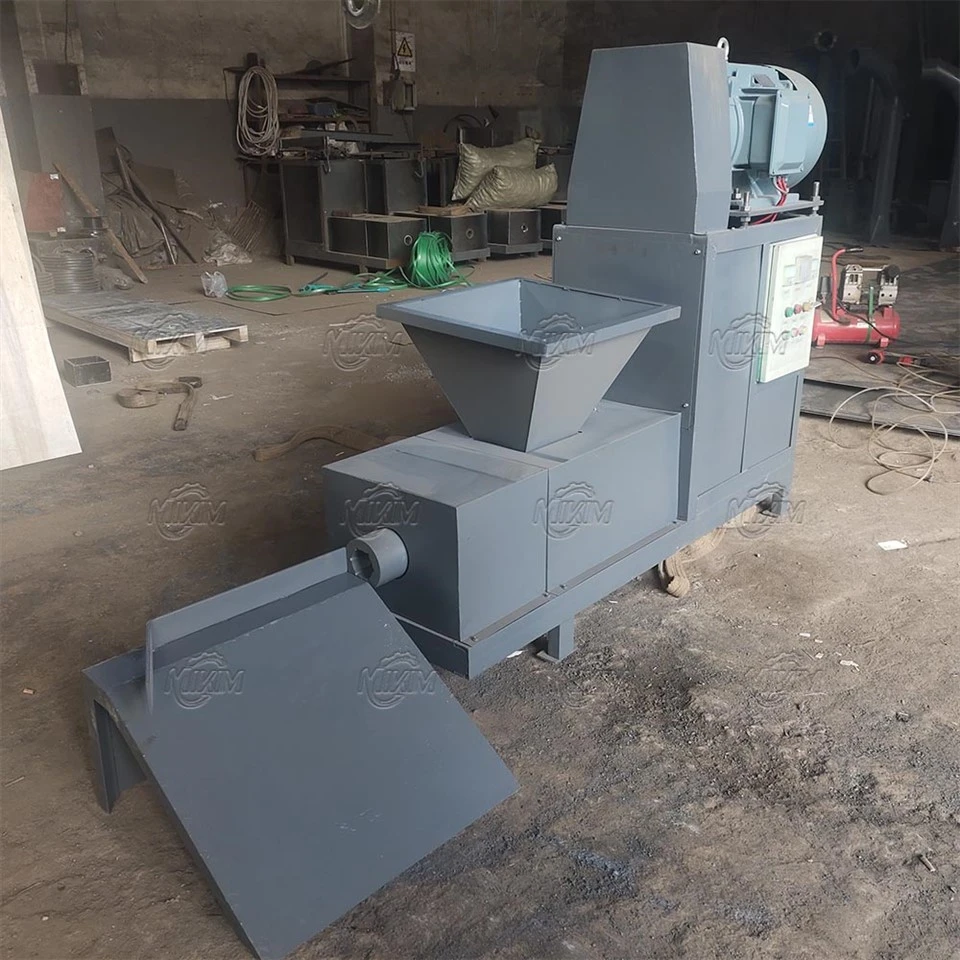
The forming range has two models, and the table below is the complete forming-stage specification:
| Model | BJ-50 | BJ-80 |
|---|---|---|
| Diameter | 50 mm | 80 mm |
| Capacity | 200-250 kg/h | 250-300 kg/h |
| Power | 18.5 kW | 22 kW |
| Weight | 550 kg | 700 kg |
| Outline Size | 1800 x 600 x 1600 mm | 1800 x 700 x 1600 mm |
| Moisture | 5%-12% | 5%-12% |
Diameter is set by the forming sleeve, so a line is built around one diameter unless the sleeves are changed to switch. Where charcoal powder rather than sticks is the finished product, the charcoal powder extruder range covers that forming route.

Line-level items that are confirmed per project
| Line item | Specification |
|---|---|
| Line target | 2 t/h of formed sticks feeding carbonisation |
| Forming stage | 7 to 8 stick machines in parallel |
| Forming-stage installed power | 154-176 kW |
| Formed product | Round sticks, 50 mm or 80 mm diameter |
| Feed moisture window | 5%-12% |
| Carbonisation | Continuous drum furnace, feed below 15 mm, up to 700 deg C, carbon content up to 92%, PLC control |
| Furnace heat | Recovered combustible flue gas, or natural gas, configured per project |
| Char output | Confirmed on a trial run, since yield depends on feedstock and conditions |
| Line total power and footprint | To be confirmed against the factory technical confirmation sheet |
Where a lift or horizontal furnace is supplied instead, output follows the furnace family. The lift furnace delivers about 2.5-12 tonnes of finished char per day depending on the number of sections, while horizontal units span 16 models from 50 to 4000 type.
10Which Raw Materials and End Fuel Markets Suit a Combustible Charcoal Stick Production Line?
The listed feed for this machine is specific: bamboo powder, sawdust, wood bran and rice husk. These are the materials the machine is described as handling.
Reference: IEA Bioenergy biomass programme
Bamboo powder, sawdust, wood bran and rice husk as listed feed
Wood-based feeds - sawdust, wood bran and bamboo powder - form predictably because they are relatively uniform and carry enough natural lignin. Materials outside this list, including rice straw and napier grass, are not stated as supported feed; their forming behaviour is confirmed on a trial run before it is written into a contract. For the fine-particle end of the wood feed, the wood shavings briquette maker page shows how shavings are handled.
Charcoal supply, industrial fuel, barbecue and soil amendment markets
Markets that fit a stick-and-carbonisation line:
- Charcoal supply into domestic cooking-fuel markets where lump charcoal is the established product.
- Industrial fuel for boilers and kilns that accept solid fuel.
- Barbecue and shisha charcoal, where stick shape and carbon content drive value.
- Soil amendment and activated-carbon feedstock, where consistent carbon content matters more than size.
Where the charcoal is destined for a named market, the furnace settings and stick dimensions should be fixed at design stage rather than adjusted after commissioning.
11What Cost and Product Advantages Does a Barbecue Charcoal Stick Production Line With Carbonisation Offer?
Binder-free screw extrusion cuts three running costs that a binder-based line keeps paying.
The running cost of a binder-free line: one inventory, no mixing step
Because the machine forms sticks with heat and pressure alone, there is no binder to buy. That removes three costs at once: the recurring starch or resin purchase, the batching and mixing step, and a second input to store and move. A binder-based line holds two inventories and keeps their ratio right every shift; a binder-free line holds one.
Higher-value charcoal output from the same feedstock
Because the sticks are pure feedstock, the furnace turns them into mechanical charcoal whose density and heat value track the raw material, and charcoal sells into a higher-value market than densified fuel alone. Running both stages in one plant also means recovered flue gas fires much of the process, cutting external fuel. The trade is complexity: two linked stages mean two sets of settings to hold, and the balance between them has to be designed rather than discovered on site.
12How Do You Configure Christian's 2 t/h Biomass Briquette Production Line and Two Feedstock Cases?
The forming line and the furnace
A 2 t/h stick line with the carbonisation furnace included is the two-stage plant described above. The forming stage is seven to eight stick machines in parallel - the larger unit rated 250-300 kg/h on 22 kW - feeding a continuous furnace matched to the stick shape. This is a 2T/h biomass briquette production line including carbonisation furnace in the sense the keyword uses it: a line output target reached by paralleling machines, with the furnace as a built-in stage.
Both feedstocks at 13 percent moisture
Your Case 1 is 80% rice straw plus 20% rice husk at 13% moisture; your Case 2 is dried napier grass at 13% moisture. Both run on the same stick machine and preparation line. Two points apply to both. First, 13% sits slightly above the 12% top of the forming window, so a light drying pass through the airflow dryer brings each into range - a small, routine step. Second, rice straw and napier grass are not on the machine's listed feed list, so their forming behaviour and charcoal yield are confirmed on a trial run. For Case 1, the rice husk fraction is abrasive, so plan for sleeve and screw wear as a running cost.
Both cases can be demonstrated on a trial run before you commit, and the offer follows your feedstock rather than a catalogue. Ask us to size the forming stage for your material and the reply comes back as an itemised quotation for a biomass briquette production line on an EXW/FOB basis, CIF available on request, plus the preparation and trial-run plan for both cases.
13How Are Installation, Commissioning, Warranty and Spare Parts Handled for a Stick Line?
A two-stage line is commissioned in sequence rather than simply delivered. The forming stage is commissioned first and run until it holds the stick dimensions you specified, because everything downstream depends on that shape. The furnace is then brought up with the stick machine feeding it, and the trial run doubles as the plant's first yield measurement.
The commissioning sequence for a two-stage line
Commissioning runs from preparation to product. First the crusher and airflow dryer are set for the right feed size and moisture. Then the forming stage is tuned until sticks come off at the specified diameter and density. Finally the furnace is warmed and stabilised on that feed. The furnace-side detail is covered on the carbonisation furnace range.
Wear parts and the spares package for abrasive feed
The wear parts to stock are the forming sleeve and the screw, because both take the abrasion and heat of extrusion. On abrasive feed such as rice husk their life is shorter than on clean wood, so a spares package agreed at order stage keeps the first months from depending on air freight. The warranty runs for the standard period and covers defects in manufacture. Emissions and local compliance are handled against your project location and the furnace documentation supplied with the equipment.
14FAQ:
Q1: What stick diameter does the line produce, and can it switch between 50 mm and 80 mm?
The line forms round sticks of 50 mm or 80 mm diameter, set by the forming sleeve. One line is normally built around a single diameter; switching means changing the sleeves, so it is best fixed at order stage.
Q2: Why does a 2 t/h line use seven or eight stick machines instead of one large press?
The forming range has two models, and the larger is rated 250-300 kg/h, so no single machine reaches 2 t/h. The line reaches it by paralleling seven units at the top rate for 2,100 kg/h or eight at the bottom rate for 2,000 kg/h. Paralleling also lets one machine be serviced while the rest keep running.
Q3: Can an 80 percent rice straw plus 20 percent rice husk blend at 13 percent moisture be formed without a binder?
It can be formed without a binder, because forming relies on heat and pressure rather than an additive. The 13% moisture sits slightly above the 12% top of the window, so a light drying pass through the airflow dryer brings it into range. Rice straw is not on the machine's listed feed, so the blend is confirmed on a trial run.
Q4: Does dried napier grass at 13 percent moisture need extra drying before the stick machine?
Yes - a light drying pass. At 13% the grass is slightly above the 12% top of the window, so it goes through the airflow dryer before forming. The same preparation line serves both of your feedstock cases.
Q5: Does 2 t/h mean the line produces 2 t/h of finished charcoal?
No. 2 t/h is the rate at which the forming stage produces green sticks feeding carbonisation. Charcoal output is lower, because carbonisation removes moisture, volatiles and mass, and the exact yield depends on feedstock and conditions. That yield is established on a trial run rather than quoted as a generic figure.
Q6: How is the line quoted, and how do EXW, FOB or CIF terms apply to shipment?
The offer is itemised line by line on an EXW or FOB basis, with CIF available on request. The delivery clock starts at the deposit and the signed technical sheet; payment and shipping terms sit on the same itemised quotation.


Hot Tags: 2T/h Biomass Briquette Production Line, China 2T/h Biomass Briquette Production Line manufacturers, suppliers, factory, Biomass automatic briquetting machine, Stamping Biomass Briquetting, stamping briquette machine, briquette presses, Wood Log Briquetting Press Machine, biomass briquettes machine manufacturer
You Might Also Like


Send Inquiry
