


Why Adjust The Parameters Of A Small Biomass Pellet Mker Machine?
content
The core objective of parameter tuning is to balance the pressing force, feed rate, and forming speed of the biomass sawdust pellet machine to produce uniform and high-quality pellets. The first step is adjusting the gap between the pressure roller and the die, a key parameter affecting extrusion pressure. The optimal gap is 0.1-0.3mm. Too large a gap results in insufficient extrusion pressure, low density, and a loose, easily crumbling finished product; too small a gap leads to increased wear on the pressure roller and die, increased energy consumption, and a higher risk of raw material carbonization. Adjustment method: After turning off the power, rotate the pressure roller shaft and measure the gap with a feeler gauge. Fine-tune the gap gradually using the adjusting bolts to ensure uniformity around the edges. When processing hard materials (such as hardwood chips), adjust the gap to 0.1-0.2mm to increase extrusion pressure; when processing soft materials (such as straw and softwood chips), adjust the gap to 0.2-0.3mm to avoid excessive extrusion and increased energy consumption.
Feed speed adjustment needs to match the production capacity and raw material characteristics of the small ring die wood pellet making machine, achieved through a frequency converter system or feed baffle. If the feeding speed is too fast, the raw material will accumulate in the pressing chamber, preventing sufficient extrusion and resulting in uneven density in the finished product. If the feeding speed is too slow, the equipment will have a high idling rate, reducing capacity, and the raw material will be prone to carbonization due to prolonged friction within the pressing chamber. Debugging tips: After starting the biofuel sawdust pellet machine and preheating it by idling, gradually increase the feeding speed while observing the motor current and the condition of the finished product. The optimal feeding speed is when the current stabilizes at 80%-90% of the rated value, and the finished product surface is smooth and free of loose material. When processing fine-grained raw materials, the feeding speed can be appropriately increased; when processing coarse-grained raw materials, the feeding speed should be slowed down to ensure sufficient extrusion.
The mold rotation speed affects molding time and finished product density. Different machine models have different rotation speeds: small flat die wood pellet making machines have lower rotation speeds (200-300 r/min), suitable for processing soft raw materials; excessively high speeds can easily cause the finished product to break. Small ring die wood pellet making machines have higher rotation speeds (500-800 r/min), suitable for large-scale production; the rotation speed can be fine-tuned according to the required finished product density. Higher rotation speeds result in shorter molding times, requiring appropriate feeding speeds to avoid raw material accumulation. Furthermore, the cutter position adjustment affects the finished product length. It is recommended to control the finished product length at 2-4 times the aperture diameter, achieved by adjusting the distance between the cutter and the mold. Finished products with uniform length are easier to store and transport, and burn more stably.
Parameter Adjustment Precautions: A small-scale test must be conducted before mass production, gradually fine-tuning parameters according to raw material characteristics and finished product requirements. If raw material characteristics change during production (e.g., moisture content, particle size fluctuations), the parameters of the small biomass pellet making machine must be adjusted promptly. After each parameter adjustment, observe for 10-15 minutes to confirm stable finished product quality before continuing production.
Related equipment


| Model | Power | Mold Hole | Capacity for industrial solid | Capacity for biomass | Pellet size(mm) |
| MKYK-36 | 45kw | 36 | 0.5-1.0 | 1.0-1.5 | 32*32*50-100 |
| MKYK-48 | 75kw | 48 | 1.0-1.5 | 1.5-2.5 | 32*32*50-100 |
| MKYK-72 | 110kw | 72 | 2.0-2.5 | 2.5-3.5 | 32*32*50-100 |
| MKYK-90 | 132kw | 90 | 2.0-2.5 | 3.5-5.0 | 32*32*50-100 |
| MKYK-120 | 200kw | 120 | 3.0-4.0 | 4.0-6.0 | 32*32*50-100 |
| MKYK-150 | 250kw | 150 | 4.0-6.0 | 6.0-10.0 | 32*32*50-100 |
about us
customer visit

certificates of honor

certificates of honor

certificates of honor
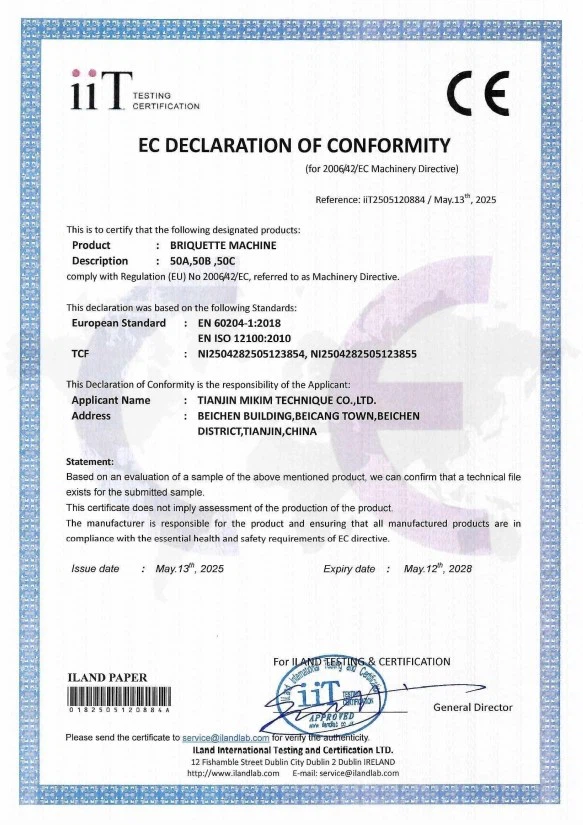
certificates of honor


