


Tips on raw materials and processing for small flat die wood pellet making machines
content
Raw material pretreatment is a prerequisite for stable production of mini wood pellet machines. Regardless of the raw material used, it must meet three core requirements: particle size, moisture content, and impurity content. These are also the general principles for small wood fuel pellet making machines. Regarding particle size control, the suitable particle size for wood pellet machines is 2-5mm. If the raw material particle size is too large (over 8mm), it can easily clog the die holes, accelerate the wear of the pressure rollers, and lead to equipment failure. If the particle size is too small (below 1mm), it will increase extrusion resistance, reduce production efficiency, and result in insufficient particle density. During processing, a hammer mill and grading screen are required. Forestry raw materials (wood chips, branches) are crushed and then screened through a 2-5mm screen. Agricultural raw materials (straw, corn cobs) require secondary crushing to ensure uniform particle size. Unqualified raw materials are reprocessed.
Moisture content control is the core of pretreatment, with an optimal range of 12%-15%. This is crucial for small biomass pellet maker machines to rely on lignin self-bonding for pellet formation. Excessive moisture content (above 18%) causes raw materials to stick to the feed inlet and mold, leading to jamming, loose and cracked pellets, and excessive smoke during combustion. Insufficient moisture content (below 10%) makes it difficult for lignin to soften and melt, resulting in difficult molding and increased equipment wear. To adjust moisture content, wet raw materials can be dried using a drum dryer (80-100℃). For dry materials (such as wood chips or rice husks), spray water evenly with a spray bottle while stirring to ensure uniform moisture distribution. The standard for judging this is that the raw material "clumps together when squeezed, but crumbles easily when lightly touched, with no obvious water residue."
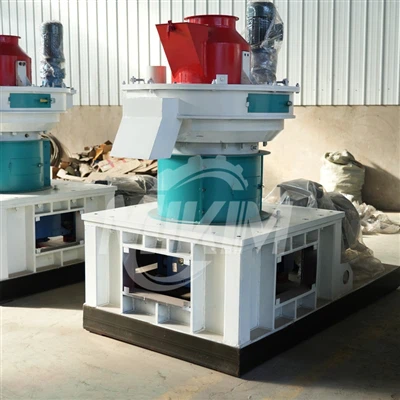
Impurity removal is crucial for ensuring equipment lifespan and pellet quality. Hard impurities such as stones, metal fragments, and glass must be thoroughly removed from the raw materials. These impurities can severely wear down the pressure rollers and molds of the ring die wood pellet making machine, even causing the main shaft to bend, and affecting the purity of pellet combustion. The processing employs a triple method: manual sorting, magnetic separation, and sieve filtration. Large impurities are removed manually, metal fragments are adsorbed by a magnetic separator, and fine impurities are filtered through a grading sieve, ensuring an impurity removal rate of over 99%.
Furthermore, raw materials must be pre-dried to remove mold, preventing moldy materials from affecting the pellet's combustion performance and storage stability. Pre-treated raw materials must be processed as soon as possible, with a storage time not exceeding 24 hours to prevent secondary moisture absorption and ensure stable production efficiency and pellet quality at the vertical ring die pellet mill.
Related equipment
about us
Customer visit

Certificate of Honor

FAQ
1.What is the price of equipment for the Small Wood Pellet Mill?
It costs approximately US$1,500.00 - 25,000.00
2. If equipments have some quality problem, how would you deal with?
We will responsible for all the quality problems. Change all the parts for free.


